
Quick technical guide: This article explains mccb trip units explained: thermal-magnetic vs electronic protection for panel builders, contractors, maintenance teams and industrial electrical buyers.
Two molded-case circuit breakers can have the same frame size and rated current yet behave very differently during a fault.
The difference may be inside the breaker.
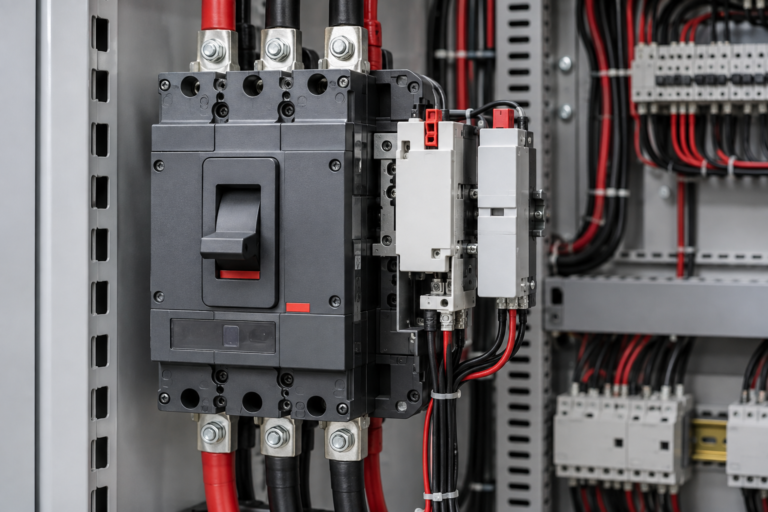
An MCCB's trip unit determines how the breaker responds to abnormal current. Some designs use thermal and magnetic elements. Others use electronic sensing and provide additional adjustment of protection functions.
For panel builders and industrial buyers, this matters because "250 A MCCB" is not a complete specification.
The breaker also has to suit the circuit, available fault current, required protection characteristics and coordination strategy.
What does the trip unit do?
An MCCB carries current during normal operation and opens the circuit when its protection system detects conditions that require tripping.
ABB describes thermal-magnetic MCCBs as providing protection against overloads and short circuits.
ABB Group
+1
The trip unit decides when that operation occurs according to its designed time-current characteristic.
That distinction is useful during troubleshooting. A breaker that trips is not automatically defective. It may be responding correctly to an overload or fault.
Before resetting a repeatedly tripping MCCB, the cause needs investigation.
How does a thermal-magnetic trip unit work?
The name describes its two basic protection mechanisms.
Thermal protection
The thermal element responds to sustained overcurrent.
If current remains above the permitted operating level, heating builds in the trip mechanism. The response is time-dependent: a modest overload can take longer to operate the breaker than a much larger overload.
ABB describes the overload region of thermal-magnetic protection as the zone where the thermal element normally operates.
ABB Group
This inverse-time behaviour helps distinguish a sustained overload from a brief current increase.
Magnetic protection
Short circuits require much faster interruption.
The magnetic element responds when current rises to the instantaneous trip region defined by the breaker.
ABB distinguishes this short-circuit zone from the overload zone and notes that magnetic protection is normally responsible for thermal-magnetic breaker operation at high fault currents.
ABB Group
So the same MCCB can respond differently to a moderate long-duration overload and a severe short circuit.
Fixed and adjustable settings are not the same thing
Not every thermal-magnetic MCCB provides identical adjustment.
Some breakers have fixed overload characteristics. Others allow one or more settings to be adjusted.
For example, ABB currently documents thermal-magnetic E150 MCCBs with overload and short-circuit protection, while individual models can have fixed trip characteristics.
ABB Group
+1
Other MCCB families can provide adjustable instantaneous pickup or other settings.
The presence of a dial on one breaker should never be used to assume what another breaker can adjust.
Check the actual trip-unit documentation.
What changes with an electronic trip unit?
An electronic trip unit measures current electronically and uses that information to determine when the breaker should trip.
This can provide much more control over the protection curve.
Siemens describes its electronic MCCB trip units as microprocessor-based true-RMS sensing devices with multiple adjustable trip configurations.
Siemens Industry Support
Depending on the model, settings can include:
L — Long-time protection
Used for overload protection.
S — Short-time protection
Provides short-circuit protection with a controllable pickup and, on applicable trip units, a time delay.
I — Instantaneous protection
Responds to high short-circuit current without an intentional delay according to the device settings.
G — Ground-fault protection
Available on suitable electronic trip units for defined ground-fault protection applications.
This is where terms such as LI, LSI and LSIG come from.
They describe the protection functions provided by the trip unit.
What does LSI mean?
An LSI trip unit combines:
L: Long-time
S: Short-time
I: Instantaneous
Siemens' current 3VA electronic MCCB documentation shows LSI trip units with separate long-time, short-time and instantaneous functions.
Siemens Industry Support
The practical benefit is not simply "more settings."
It gives the protection designer more control over how the breaker responds at different current levels.
That can become important when several protective devices are installed in series.
What does LSIG add?
LSIG adds a ground-fault function to the LSI arrangement.
Siemens currently offers 3VA electronic trip units with LSIG configurations and adjustable protection parameters.
Siemens Ausschreibungstexte
+1
Ground-fault protection is an engineered protection function. Its suitability, sensing arrangement and settings depend on the electrical system.
Do not assume that choosing an LSIG breaker automatically makes every installation correctly protected against earth or ground faults.
The system design still matters.
Why does short-time delay exist?
Consider a main distribution board with an incoming MCCB feeding several downstream breakers.
A fault occurs on one outgoing circuit.
Ideally, the protective device closest to that fault should clear it while healthy parts of the installation remain energized.
ABB defines selectivity as a condition where the protective device immediately upstream of the fault operates while the other protective devices remain unaffected.
ABB Group
Adjustable short-time pickup and delay can be part of achieving that coordination.
For example, Siemens documents electronic MCCBs where short-time pickup and delay can be adjusted independently.
Siemens Ausschreibungstexte
The upstream breaker can therefore be coordinated with downstream protection where the equipment and engineering study permit it.
This is not something to configure by guesswork.
A higher delay is not automatically better
If delaying an upstream breaker can improve selectivity, it may seem sensible to increase the delay as much as possible.
That reasoning ignores fault energy and equipment withstand.
During a fault, current continues to flow until a protective device interrupts it.
Protection settings therefore have to balance several requirements, including conductor protection, equipment capability, selectivity and fault-clearing performance.
A coordination study uses actual device curves and system fault calculations to establish suitable settings.
The adjustable dial is not a substitute for that engineering work.
Frame rating and trip setting can be different
Another source of confusion appears when an MCCB frame can accept or incorporate protection settings below the frame's maximum current.
For example, Siemens currently documents an electronic 250 A MCCB with an adjustable long-time protection setting from 100 A to 250 A.
Siemens Ausschreibungstexte
That example belongs to a specific Siemens breaker and should not be treated as an INTEKS specification.
It illustrates the distinction between the breaker's physical/rated platform and the current setting applied through its trip unit.
When purchasing a replacement, record the complete breaker and trip-unit information rather than reporting only the number printed most prominently on the front.
Breaking capacity is still a separate requirement
A sophisticated electronic trip unit does not remove the need to check the breaker's short-circuit breaking capacity.
The MCCB must be suitable for the prospective fault current at the point where it is installed.
Breaking capacity can also change with operating voltage.
Current Siemens product data makes this easy to see. One electronic MCCB is documented with different short-circuit breaking capacities at 415 V and 690 V.
Siemens Ausschreibungstexte
This is why a purchasing request containing only:
"250 A electronic MCCB"
is incomplete.
The system voltage and required fault-interruption capability still need to be known.
Electronic does not automatically mean LSIG
Electronic trip units are available in different configurations.
ABB's MCCB documentation includes electronic breakers with LI, LIG, LSI and LSIG arrangements.
ABB Library
Siemens likewise publishes different electronic trip-unit options within its MCCB families.
Siemens Industry Support
If the project needs short-time delay, confirm that the selected trip unit actually provides an S function.
If ground-fault protection is required, verify the G function and the associated sensing requirements.
Do not specify "electronic MCCB" and expect every advanced protection feature to be included.
When can a thermal-magnetic MCCB make sense?
There is nothing inherently outdated about thermal-magnetic protection.
For applications where straightforward overload and short-circuit protection meets the engineering requirement, a thermal-magnetic MCCB can provide an appropriate solution.
ABB continues to offer thermal-magnetic MCCBs for applications including switchboards, motor control centres and power panelboards.
ABB Group
The decision should come from the required protection behaviour rather than from assuming that a more complex trip unit is always better.
When does an electronic trip unit become useful?
Electronic protection becomes particularly useful when the design requires more adjustable protection characteristics.
Examples include distribution systems where downstream and upstream breakers need careful coordination, applications needing adjustable short-time protection, or projects requiring compatible ground-fault functions.
Some electronic trip units also offer metering, displays or communication capabilities.
For example, Siemens documents current 3VA electronic MCCBs with LCD, communication and measurement options on selected configurations.
Siemens Ausschreibungstexte
+1
Those are product-specific capabilities. They should not be assumed for every electronic MCCB.
What should maintenance record before replacing an MCCB?
Do not remove the old breaker until its settings have been documented.
Take clear photographs of the breaker label and trip unit.
Record the manufacturer and complete product reference, rated current, system voltage, number of poles, breaking-capacity information, trip-unit type and every adjustable setting.
Also note accessories connected to the breaker, such as auxiliary contacts, shunt trips or undervoltage releases where present.
If the breaker has tripped because of a fault, replacing it with an identical unit without investigating the fault is not a repair strategy.
Find the cause first.
A better MCCB purchasing request
Instead of:
"Need 400A MCCB, 3 pole."
provide the information that defines the application:
System voltage
Number of poles
Required rated current
Prospective short-circuit current or specified breaking capacity
Thermal-magnetic or electronic trip requirement
Required protection functions
Required adjustable settings
Installation or mounting arrangement
Accessories
Existing breaker reference for replacement work
Coordination requirements where applicable
If the required protection settings come from an engineering study, include them rather than asking the supplier to infer them from the breaker current.
Sending an MCCB enquiry to INTEKS
For replacement work, send clear photographs of the complete MCCB label, trip-unit face and existing settings.
For a new panel, provide the electrical design requirements, system voltage, current, fault-level requirement, number of poles and required protection functions.
INTEKS supplies industrial electrical protection and control components for panel builders, contractors, maintenance teams and industrial users. MCCB selection should be based on the circuit and protection requirement rather than frame size or current rating alone.
Frequently asked questions
What is the difference between thermal-magnetic and electronic MCCB protection?
Thermal-magnetic trip units use thermal behaviour for overload protection and magnetic operation for high-current short circuits. Electronic trip units sense current electronically and can provide more adjustable protection functions depending on the model.
ABB Group
+1
What does LSIG mean on an MCCB?
LSIG refers to long-time, short-time, instantaneous and ground-fault protection functions. The available adjustments and sensing arrangements depend on the exact trip unit.
Siemens Industry Support
Is an electronic MCCB always better than a thermal-magnetic MCCB?
No. The correct choice depends on the protection requirements. Straightforward installations may not need the additional adjustability or functions of an electronic trip unit.
Can I change MCCB trip settings to stop nuisance tripping?
Settings should not be increased simply to prevent trips. Repeated operation can indicate overload, a downstream fault, incorrect coordination or an unsuitable existing setting. Verify the load and protection study before changing protection parameters.
Is MCCB current rating enough to choose a replacement?
No. Voltage, poles, breaking capacity, trip-unit characteristics, protection settings, accessories and the circuit application can all affect replacement selection.
Related INTEKS guides
- Current Transformer Selection: Why the CT Ratio Is Only the Starting Point
- Control Transformer Sizing: Why Adding Up Coil Ratings Is Not Enough
- Browse all INTEKS technical insights
For project requirements, component identification or a panel enquiry, contact the INTEKS team with the relevant rating, application and existing product details.
For the applicable standard and current edition, consult the official IEC publication search.