Quick technical guide: This article explains soft starter vs star-delta starter: choosing the right starting method for an industrial motor for panel builders, contractors, maintenance teams and industrial electrical buyers.
A motor starts correctly, reaches full speed and runs all day without trouble. That does not mean its starting method is ideal.
Starting is one of the more demanding periods in a motor's operating cycle. Current rises, torque is applied to the driven equipment, and the electrical network sees a sudden change in demand.
For a small motor on a strong supply, direct-on-line starting may be acceptable. As motor size and load requirements change, designers often look at reduced-current starting methods.
Two options regularly compared are the star-delta starter and the soft starter.
They both reduce the impact of motor starting, but they do it in very different ways.
Why reduce motor starting current?
When an induction motor is connected directly to the supply, its starting current can be much higher than its normal running current.
That current can contribute to voltage dips in the supply network. The sudden development of motor torque can also put mechanical stress on couplings, belts, gearboxes, pumps and other driven equipment.
ABB describes soft starters as a method of reducing motor starting current while also reducing electrical and mechanical stress. Siemens similarly states that its soft starters are designed to limit starting current and torque, helping reduce mechanical stress and line-voltage dips.
ABB Group
+1
Reduced-current starting is therefore not only an electrical issue. The machine itself matters.
How does a star-delta starter work?
A star-delta starter uses contactors to change the connection of the motor windings during starting.
The motor initially starts with its windings connected in star.
After it accelerates, the control system disconnects the star arrangement and changes the motor to its normal delta connection.
This reduces the voltage applied across each winding during the initial start.
Siemens states that star-delta starting reduces the starting current to approximately one-third of the corresponding direct-on-line delta starting current. Motor starting torque is also reduced to roughly one-third.
Siemens Industry
That second point is critical.
Reducing current also reduces the torque available to accelerate the load.
Why starting torque can become a problem
Imagine two motors with identical nameplate ratings.
One drives a lightly loaded fan.
The other starts a heavily loaded conveyor.
The electrical ratings may look similar, but their starting requirements are not.
A star-delta starter can work where the motor develops enough torque in star connection to accelerate the load. If the load demands more torque than the motor can provide during the star period, the motor may accelerate slowly or fail to reach the speed required for a successful transition to delta.
This is why motor kW alone cannot determine whether star-delta starting is suitable.
The load torque and acceleration requirement have to be considered.
What happens during the star-to-delta transition?
Star-delta starting does not produce one continuous electrical ramp.
At the transition point, contactors change the winding connection.
Siemens' technical motor-starter documentation identifies switching surges in current and torque as one of the disadvantages that can occur with star-delta starting. It also notes that the startup characteristic cannot be adjusted to the machine in the same way as an electronic starting method.
Siemens Industry
Correct contactor sequencing and interlocking therefore matter.
The star and delta contactors must not be allowed to create an incorrect simultaneous connection.
Panel designers typically use electrical and/or mechanical interlocking together with appropriate timing control according to the starter design.
How does a soft starter work?
A soft starter takes an electronic approach.
Instead of physically changing the motor winding connection from star to delta, semiconductor devices control the voltage applied to the motor during starting.
ABB explains that soft starters use semiconductors in the main circuit to gradually increase motor voltage. As the voltage rises, motor acceleration and torque increase progressively toward normal operation.
ABB Library
Siemens describes the same principle: motor voltage is reduced using phase control and increased from an adjustable starting voltage toward the mains voltage over a defined ramp time.
Siemens Industry Support
The result is a controlled acceleration rather than a star-to-delta switching event.
Why soft starting can be easier on machinery
Think about a conveyor loaded with product.
An abrupt application of torque can pull suddenly on belts, couplings and the material being transported.
A controlled acceleration can reduce that mechanical shock.
ABB specifically identifies reduced mechanical wear as one of the benefits of soft starting, while Siemens states that soft start and soft stop can reduce stress on connected equipment.
ABB Group
+1
Pumps are another common example.
Depending on the hydraulic system and soft starter functions, controlled starting and stopping can help manage abrupt changes in flow and pressure.
The actual benefit depends on the application. A soft starter should not be treated as a universal cure for mechanical or hydraulic design problems.
Soft starter vs star-delta: starting current
Both methods can reduce starting current compared with direct-on-line starting.
The difference is in how that reduction is achieved.
A star-delta starter uses a defined winding configuration. Siemens describes star starting current as roughly one-third of the corresponding delta starting current.
Siemens Industry
A soft starter can provide adjustable current or voltage control depending on the product.
For example, Schneider Electric's current documentation for its ATS22 allows starting-current limiting to be configured according to the application. The specific available settings belong to that product family and should not be transferred to another soft starter.
Schneider Electric
That adjustability can make commissioning more flexible when the motor and driven load require a particular acceleration behaviour.
Soft starter vs star-delta: panel complexity
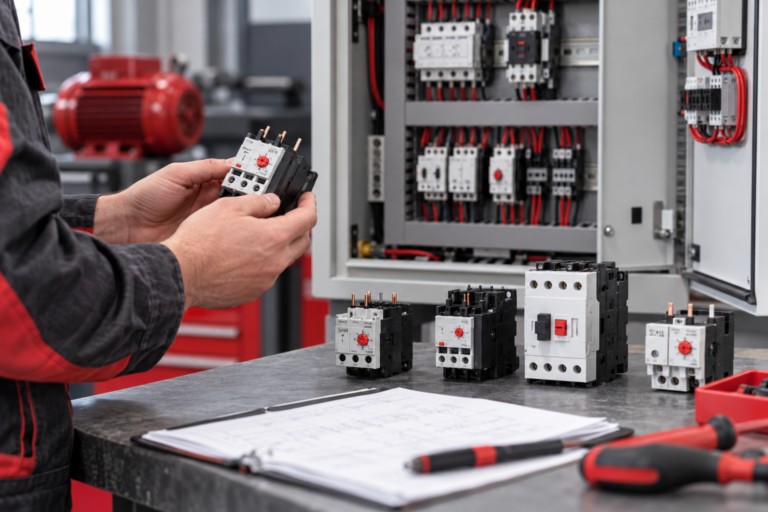
A conventional star-delta starter normally requires three contactors:
Main contactor
Star contactor
Delta contactor
It also requires appropriate interlocking and transition control.
Six motor leads need to be available so the winding connections can be changed externally.
Siemens identifies the additional cabling, contactors, timer or PLC control and panel space as disadvantages of conventional star-delta arrangements.
Siemens Industry
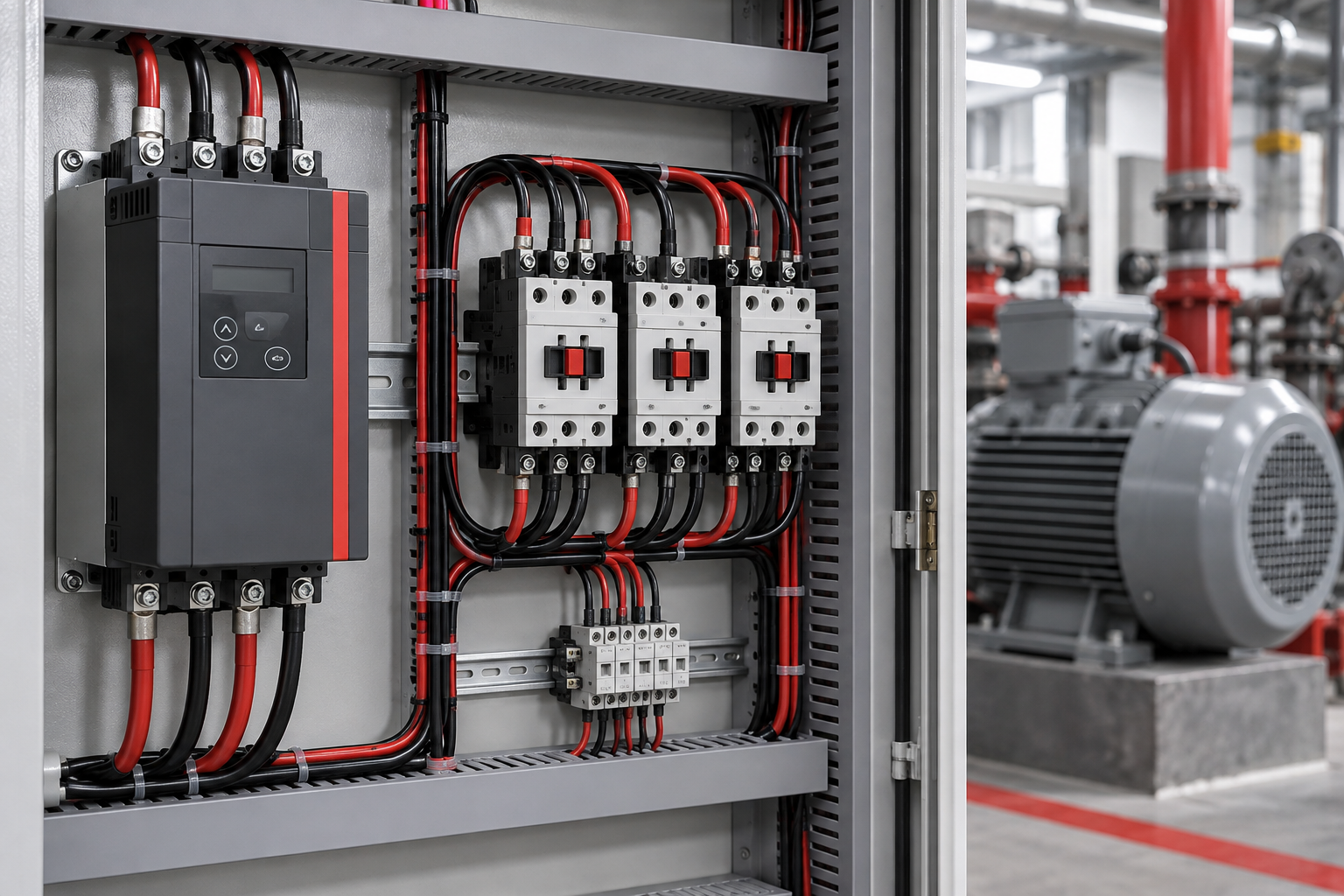
A soft starter can simplify the power arrangement because the electronic device performs the controlled starting function.
ABB describes its basic PSR soft starter as more compact than a conventional star-delta solution.
ABB Group
This does not mean every soft-starter panel is automatically smaller. Bypass arrangements, protection, ventilation, cable spacing and accessories still influence panel design.
What is a bypass contactor?
Once the motor reaches full speed, continuous semiconductor control may no longer be necessary.
Some soft starters therefore use a bypass arrangement.
With an integrated bypass, current is routed around the power semiconductors after the motor reaches normal operation. This reduces losses and heat inside the soft starter during continuous running.
Siemens identifies integrated bypass as a method of reducing operating losses in its SIRIUS range. ABB also documents built-in bypass on applicable soft starters.
Siemens
+1
Other soft-starter designs may require an external bypass arrangement.
Check the exact product rather than assuming the feature is included.
Does a soft starter replace motor protection?
Not automatically.
Some advanced soft starters include electronic motor-overload and other protection functions. Simpler units may depend on separate protective devices.
ABB's basic PSR documentation, for example, describes combining the soft starter with a manual motor starter for overload and short-circuit protection.
ABB Electrification
Siemens documents other soft-starter families with integrated electronic motor-overload protection.
Siemens Industry Support
The lesson is straightforward: "soft starter" describes a starting technology, not a guaranteed list of protection functions.
Check what protection is actually built into the selected model and what the feeder still requires externally.
Is a soft starter the same as a VFD?
No.
A soft starter controls the motor primarily during starting and, where supported, stopping. Once normal operation is reached, the motor generally runs at the frequency supplied by the electrical network.
A variable-frequency drive controls motor frequency and voltage, allowing motor speed to be varied during operation.
If a conveyor needs adjustable production speed or a pump needs continuous speed control, a VFD may be considered.
If the motor only needs a controlled start and then operates at normal fixed speed, a soft starter may be a simpler option.
The application determines which technology makes sense.
Can every motor use star-delta starting?
No.
The motor has to be suitable for the required winding connection at the available supply voltage, and all necessary winding terminals must be accessible.
A motor with only three accessible power terminals cannot be converted into a conventional externally switched star-delta arrangement.
The motor nameplate and connection diagram should be checked before designing the starter.
Do not assume suitability from motor power alone.
Choosing a soft starter also requires more than motor kW
A request such as "send a soft starter for a 30 kW motor" is incomplete.
ABB's current soft-starter selection tool uses information including motor data, main voltage, frequency, altitude, ambient temperature and load type. It then calculates expected starting behaviour to support product selection.
ABB Group
That illustrates how application-dependent soft-starter sizing can be.
A lightly loaded pump and a heavily loaded crusher with the same motor rating may impose very different starting requirements.
Starting time and number of starts per hour can matter as well because they affect the thermal duty placed on the starter.
When star-delta can still make sense
Star-delta remains a practical starting method in suitable applications.
Its components are familiar to many maintenance teams. The control principle is straightforward, and conventional contactors can often be serviced individually.
Where the motor is suitable, starting torque is sufficient and the transition behaviour is acceptable, star-delta may provide a workable reduced-current starting solution.
There is little value in replacing it merely because electronic equipment exists.
The machine requirement should drive the decision.
When a soft starter becomes attractive
A soft starter deserves consideration when controlled acceleration is useful, mechanical shock needs to be reduced, star-delta transition is undesirable, or the application benefits from adjustable starting behaviour.
It can also reduce starter wiring and component count compared with a conventional star-delta arrangement.
Siemens explicitly positions its current SIRIUS 3RW52 as an alternative to star-delta starters for fixed-speed motor applications.
Siemens
Whether that makes economic sense depends on the motor, machine, operating cycle and required functionality.
Information to collect before requesting either starter
For a new project, record the motor nameplate rather than only its kW value.
Useful information includes motor rated current, voltage, frequency and available winding connections. Then identify the driven equipment and starting conditions.
Is the motor starting loaded or unloaded?
How quickly does it need to accelerate?
How frequently will it start?
Does the machine require controlled stopping?
What protection already exists upstream?
For a star-delta replacement, also record the contactor arrangement, timer/control method and motor-terminal wiring.
For a soft-starter replacement, provide the complete existing model, settings where available and details of the application.
Sending a motor-starter enquiry to INTEKS
Clear motor and machine information makes starter selection much easier.
For a replacement, send photographs of the motor nameplate, existing starter components and panel arrangement.
For a new installation, provide the motor rated current and power, supply voltage, load type, starting frequency and preferred starting method if the engineering design has already established one.
INTEKS supplies industrial electrical control, protection and automation components for panel builders, contractors, maintenance teams and industrial users. Starter components should be selected around the motor and application rather than from motor power alone.
Frequently asked questions
Does a soft starter reduce motor starting current?
Yes. Soft starters reduce and control starting current by progressively controlling the voltage supplied to the motor during acceleration. The exact achievable current depends on the motor, load and selected soft starter.
ABB Library
+1
Why does star-delta starting reduce torque?
During star starting, each motor winding receives a lower voltage than it receives in delta operation. Siemens documents both starting current and starting torque at approximately one-third of the corresponding delta values under the described conditions.
Siemens Industry
Is a soft starter better than star-delta?
Not automatically. Star-delta can work well for suitable motors and loads. Soft starters offer adjustable starting behaviour and avoid the star-to-delta switching transition, which can be useful where smoother acceleration is required.
Does a soft starter control motor speed?
A conventional soft starter is intended primarily for controlled starting and stopping rather than continuous speed control. Applications requiring variable operating speed normally use a variable-frequency drive.
What details are needed to select a soft starter?
At minimum, provide motor current and power, supply voltage and frequency, load type, starting conditions and expected starting frequency. Environmental and installation conditions may also affect selection. ABB's current selection process additionally considers factors such as ambient temperature and altitude.
ABB Group
Related INTEKS guides
- Power Factor Correction Capacitor Banks: What They Do and When an Industrial Site Needs One
- Current Transformer Selection: Why the CT Ratio Is Only the Starting Point
- Browse all INTEKS technical insights
For project requirements, component identification or a panel enquiry, contact the INTEKS team with the relevant rating, application and existing product details.
For the applicable standard and current edition, consult the official IEC publication search.