Quick technical guide: This article explains what does the ka rating on an mcb mean? for panel builders, contractors, maintenance teams and industrial electrical buyers.
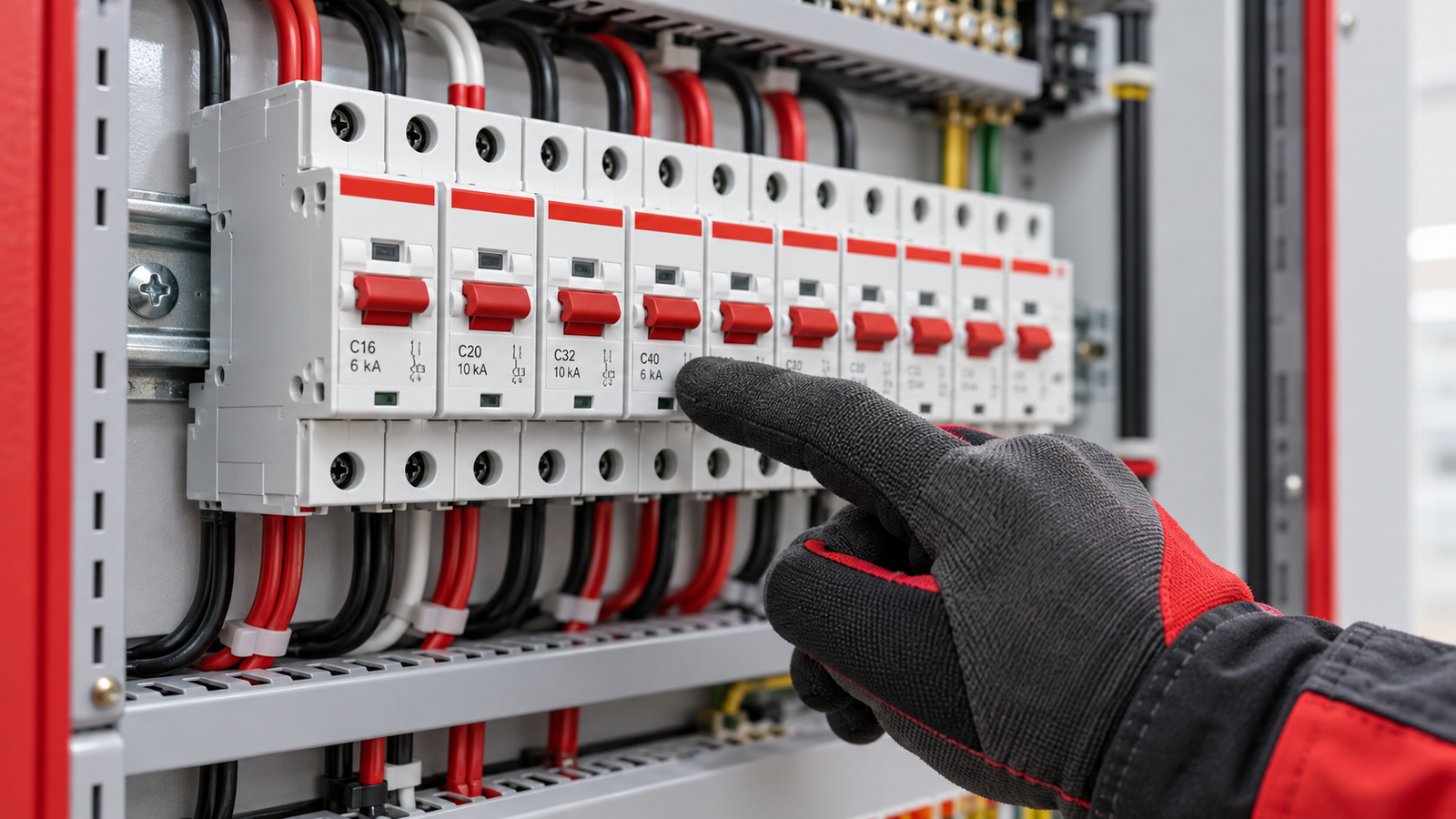
When checking an MCB, you will usually find several markings on the device. Current rating is easy to recognise: 16A, 32A, 63A and so on.
Another number often gets less attention: the short-circuit breaking capacity, normally expressed in kiloamps or kA.
That number matters because an MCB does more than handle normal operating current. It must also be capable of safely interrupting a fault when a short circuit produces a much larger current than the circuit would see during normal operation.
Understanding the kA rating helps panel builders, contractors and maintenance teams avoid selecting a breaker based only on its ampere rating.
What does kA mean on a circuit breaker?
kA means kiloampere.
One kiloampere equals 1,000 amperes.
When a circuit breaker carries a breaking-capacity marking such as 6 kA or 10 kA, the figure relates to the level of prospective short-circuit current the device is designed and tested to interrupt under the conditions defined for that breaker and its applicable standard.
This is different from the normal current rating.
A breaker marked 32A, for example, may be intended to carry a circuit with a nominal current around that rating, subject to the design of the installation. Its short-circuit rating deals with a completely different event: a fault that can produce thousands of amperes for a very short period.
Why can short-circuit current become so high?
The current flowing during a fault depends on the electrical system supplying it.
Transformer capacity, cable impedance, conductor length, supply arrangement and the location of the fault can all affect the prospective fault current available at a particular point.
This is why two 32A circuits do not automatically require identical breakers.
One may be located far downstream in an installation where impedance limits the available fault current. Another may sit close to a transformer or main distribution point where the potential short-circuit current is considerably higher.
The breaker has to be considered in the context of the system around it.
Is a higher kA rating always better?
A higher breaking capacity gives a breaker the ability to deal with a higher specified fault level, but that does not mean the largest kA figure should automatically be selected for every installation.
Circuit protection is an engineering decision.
The breaker needs to suit the operating voltage, expected load, number of poles, trip characteristics, prospective fault level and the protection arrangement of the installation.
Cost, coordination with upstream and downstream devices, panel design and applicable standards may also affect the final choice.
A larger number on the front of a breaker cannot replace those checks.
A simple 6 kA versus 10 kA example
Consider two breakers with the same current rating but different breaking capacities.
Breaker A is rated at 6 kA.
Breaker B is rated at 10 kA.
If the calculated prospective short-circuit current at the installation point is higher than 6 kA, Breaker A should not simply be assumed suitable because its normal ampere rating matches the load.
The protection design needs to account for the actual fault level and any permitted backup or coordination arrangement.
This is one reason professional breaker selection normally starts with system information rather than a product name alone.
What information should be checked when selecting an MCB?
Breaking capacity is only one part of MCB selection.
Useful information to have before choosing a device includes the number of poles, ampere rating, operating voltage, trip curve and required breaking capacity.
The application also matters.
A lighting circuit, a general distribution circuit and equipment with high starting current can place different demands on the protective device.
For an existing installation, the markings and specification of the breaker being replaced can provide useful information, but they should not be used as a substitute for checking whether the original protection was correctly selected.
IEC 60898-1 and IEC 60947-2 are not the same thing
Circuit breakers can fall under different product standards depending on their intended application.
IEC 60898-1 covers certain circuit breakers for overcurrent protection in household and similar installations. Its scope includes AC circuit breakers with rated voltage up to 440 V, rated current up to 125 A and short-circuit capacity up to 25,000 A.
IEC 60947-2 covers low-voltage circuit breakers intended to be installed and operated by instructed or skilled persons. The current edition applies to circuit breakers connected to circuits up to 1,000 V AC or 1,500 V DC, subject to the standard's detailed requirements.
For buyers, this is a useful reminder not to compare breakers only by physical size or current rating.
The standard marked on the product and its technical documentation can be important when confirming whether a breaker suits the intended application.
What should panel builders check before ordering?
Start with the electrical requirement.
Check the system voltage and number of phases. Confirm the expected load and required current rating. Determine the prospective short-circuit current at the point where the breaker will be installed.
Then check the breaker documentation against the project requirement.
If you are replacing an existing unit, record the complete product marking rather than sending only a photo of the ampere rating. Details such as pole configuration, breaking capacity and trip characteristic can change the selection.
This usually makes technical discussions with a supplier much faster.
Do not rely on appearance alone
Two MCBs can look almost identical while having different electrical characteristics.
Front markings, technical datasheets and manufacturer information should therefore take priority over assumptions based on enclosure size or visual similarity.
The same principle applies when replacing components in an older distribution board.
A physically compatible breaker is not automatically an electrically suitable replacement.
When should an electrical professional verify the selection?
Where prospective fault current is unknown, the installation has been modified, transformer capacity has changed, or protection coordination is uncertain, breaker selection should be checked by a qualified electrical professional.
Short-circuit protection is a safety function.
The safest approach is to verify the electrical conditions first and select the protective device around those conditions.
Need help identifying an INTEKS breaker?
If you are comparing MCB or MCCB options for a panel, distribution board or replacement requirement, send the INTEKS team the current rating, number of poles, operating voltage, required breaking capacity and any existing product reference available.
That information gives the team a much better starting point for identifying a suitable product option.
Frequently asked questions
Is kA the same as the ampere rating of an MCB?
No. The normal ampere rating relates to the circuit breaker's rated current. The kA figure relates to its short-circuit breaking capability under specified conditions.
What does 6 kA mean on an MCB?
A 6 kA marking indicates a specified short-circuit breaking capacity of 6,000 amperes under the conditions applicable to that device and its standard.
Can I replace a 10 kA breaker with a 6 kA breaker?
You should not make that decision from the current rating alone. The required breaking capacity depends on the prospective fault current and the protection design of the installation.
How do I know what breaking capacity my installation needs?
The prospective short-circuit current at the installation point needs to be established through the system design, calculations or appropriate electrical assessment. A qualified electrical professional should verify it where the value is uncertain.
What details should I provide when asking for an MCB?
Provide the ampere rating, number of poles, system voltage, required breaking capacity, trip curve if known, application and any existing breaker reference.
Related INTEKS guides
- Industrial Limit Switch Selection: The Small Component That Tells a Machine Where It Is
- AC-1 vs AC-3 Contactors: Why the Same Contactor Can Have Different Current Ratings
- Browse all INTEKS technical insights
For project requirements, component identification or a panel enquiry, contact the INTEKS team with the relevant rating, application and existing product details.
For the applicable standard and current edition, consult the official IEC publication search.