Quick technical guide: This article explains mpcb vs mcb: why motor protection needs more than an ampere rating for panel builders, contractors, maintenance teams and industrial electrical buyers.
A three-phase motor is marked 10A on its nameplate.
It is tempting to look for a circuit breaker with a similar current rating, install it upstream and consider the motor protected.
That approach misses an important detail: motors do not behave like ordinary steady loads.
They can draw considerably more current while starting, and they can also suffer from sustained overload conditions that heat the windings without producing the extremely high current associated with a short circuit.
This is why motor feeders use protection designed around the behaviour of the motor and the complete starter arrangement.
One device commonly encountered here is the motor protection circuit breaker, often called an MPCB, motor starter protector or manual motor starter depending on the manufacturer and market.
What is an MPCB?
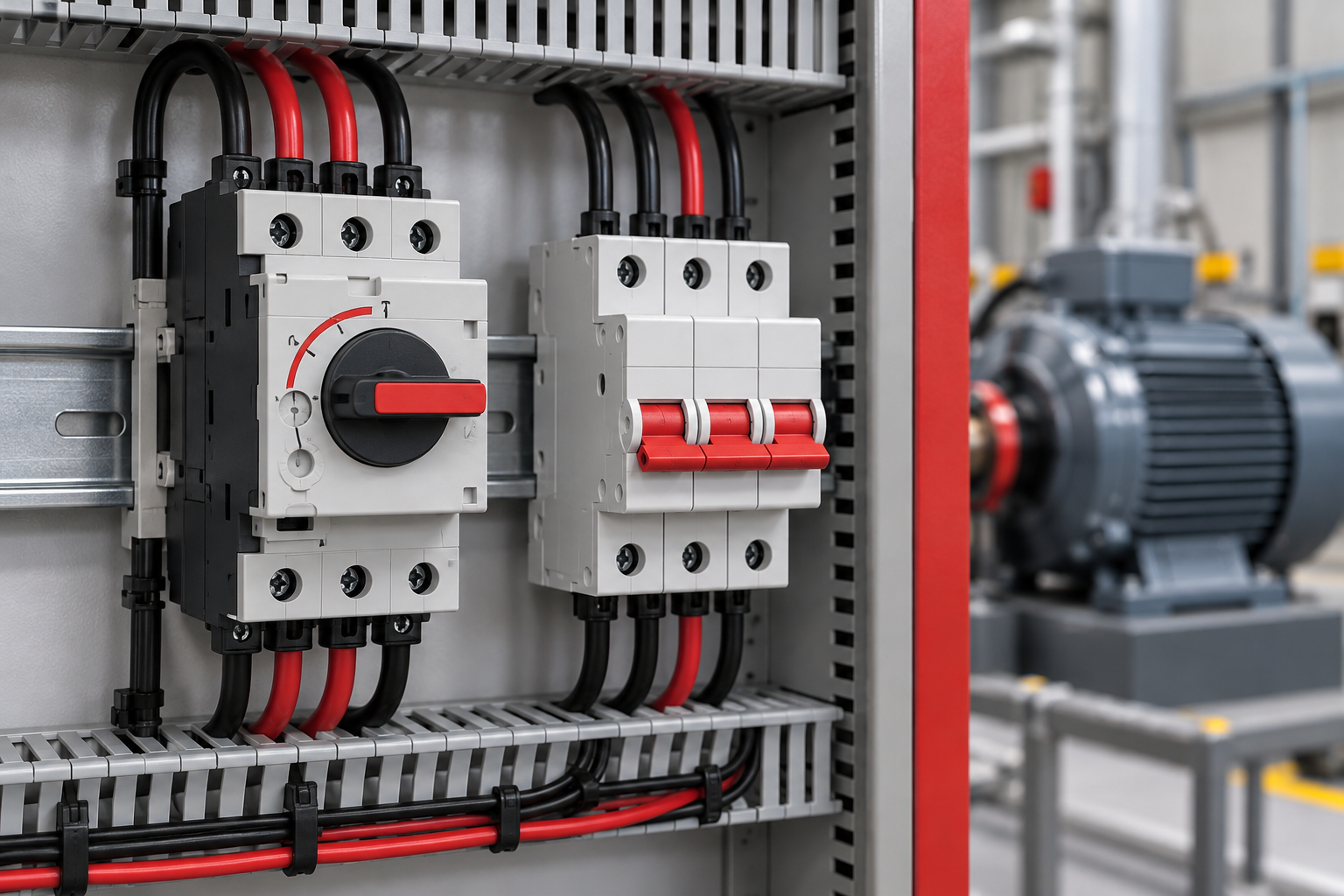
An MPCB is a protective switching device designed for motor circuits.
ABB describes manual motor starters, also known as motor protection circuit breakers or manual motor protectors, as electromechanical devices for the main circuit. Its motor-protection range combines manual switching with protection against short circuit, overload and phase failure in applicable models.
ABB Group
Siemens uses the term motor starter protector for comparable devices in its SIRIUS range. These devices use overload and short-circuit releases to disconnect a faulty motor feeder.
Siemens
+1
The terminology varies, so the name printed on a catalogue page is less important than the protection functions documented for the exact device.
Why does a motor need overload protection?
A short circuit is not the only electrical condition that can damage a motor.
Imagine a conveyor motor designed to operate at its rated mechanical load. A bearing begins to seize or material jams the conveyor.
The motor may continue trying to turn the load.
Its current rises.
That current might not be high enough to operate instantaneous short-circuit protection, but if it persists, the resulting heat can damage the motor.
Motor overload protection is intended to respond to this type of sustained overcurrent according to a defined time-current characteristic.
Siemens' current SIRIUS 3RV2 motor starter protectors include overload releases specifically designed around such time-current behaviour.
Siemens
This is different from simply reacting to a very large fault current.
What happens during a short circuit?
A short circuit requires much faster action.
Motor protection devices designed with magnetic or electronic short-circuit releases can disconnect the affected feeder when fault current reaches their operating conditions.
Siemens states that its 3RV2 motor starter protectors use short-circuit releases to isolate a faulty load feeder rapidly, while their separate overload release handles sustained overload conditions.
Siemens
+1
The exact trip values and breaking capacities vary between products.
Do not copy the figures from one manufacturer's MPCB onto another device.
The available prospective short-circuit current at the installation point still needs to be considered when selecting protection.
Why is an ordinary MCB different?
An MCB is a general circuit-protection device.
Its thermal and magnetic characteristics are selected primarily around circuit and conductor protection rather than the thermal behaviour of one particular motor.
A motor protection circuit breaker adds motor-oriented characteristics such as an adjustable overload setting on applicable models.
ABB's current manual motor starter documentation specifically lists an adjustable current setting for overload protection together with short-circuit protection.
ABB Group
That adjustment is useful because motors do not all have identical rated currents.
An MPCB covering a particular adjustment range can be set according to the motor and application following the manufacturer's instructions and the electrical design.
An ordinary MCB should therefore not be assumed to provide equivalent motor overload protection simply because its current marking looks suitable.
The current dial is not a "trip sensitivity" control
An adjustable MPCB often has a current scale on its front.
That adjustment should be treated as part of the protection design.
It is not a convenient way to stop nuisance tripping.
If a motor repeatedly trips its protection, increasing the setting without investigating the cause can expose the motor to excessive thermal stress.
Start with the motor nameplate.
Then verify the manufacturer's instructions for the protective device and starter arrangement.
Actual motor current should also be measured when troubleshooting unexplained overload trips.
Starting current changes the problem
An induction motor can draw current well above its normal running value while accelerating.
Protection therefore has to distinguish between acceptable starting behaviour and a genuine fault.
If instantaneous protection operates too close to normal motor starting current, nuisance trips can occur.
If protection is set or selected too loosely, a real fault may not be cleared as intended.
Motor starter protectors address this through coordinated overload and short-circuit trip characteristics designed for motor applications.
Siemens documents its 3RV range with adjustable overload releases and separate short-circuit releases so normal motor starting can be accommodated while fault protection remains available.
Siemens Industry Support
The appropriate device still depends on the motor, starting method and electrical system.
MPCB and contactor perform different jobs
An MPCB should not be confused with a contactor.
The contactor is the electrically operated switching element used to start and stop the motor through the control system.
The MPCB provides protection and can generally provide manual switching according to its design.
A basic direct-on-line starter may therefore use an arrangement such as:
Supply → MPCB → Contactor → Motor
The contactor can then be operated from push buttons, control relays, a PLC or another control system.
ABB specifically describes manual motor starters being combined with contactors to create starter arrangements.
ABB Group
The devices complement one another rather than performing the same function.
MPCB vs overload relay
There is another combination commonly seen in motor-control panels:
Short-circuit protective device → Contactor → Overload relay → Motor
Here, the overload relay monitors the motor's overload condition and operates the contactor control circuit when required.
An MPCB with suitable overload and short-circuit functions can integrate more of the protection into one device, but that does not mean every motor feeder should automatically be redesigned around an MPCB.
Manufacturer coordination data, required fault level, starter architecture and application requirements still matter.
There are also motor starter protectors designed specifically without overload releases.
Siemens, for example, documents certain 3RV23 devices intended for starter combinations where an external overload relay performs the overload function. Siemens explicitly states that those versions cannot provide motor overload protection by themselves.
Siemens Industry Support
That is an important warning against relying on the product category name alone.
Phase failure deserves attention
A three-phase motor can experience abnormal heating if one phase is lost while it continues operating.
ABB lists phase-failure protection among the functions of applicable manual motor starters.
ABB Group
Siemens also documents phase-failure sensitivity in applicable motor starter protectors.
Siemens Industry Support
Do not assume identical behaviour across every MPCB.
If phase-failure protection is required, verify it for the exact model being specified.
For installations needing more detailed monitoring of phase sequence, imbalance or supply voltage, a separate phase-monitoring relay may also be appropriate.
Breaking capacity still matters
Selecting the correct motor current range does not finish the protection calculation.
The device must also be capable of dealing with the prospective short-circuit conditions at its installation point, either through its own documented breaking capability or through an approved coordinated protection arrangement.
ABB's current product data illustrates why voltage must be considered here: published short-circuit breaking capacities for specific manual motor starters can change with system voltage.
Empower
The lesson is not to copy ABB's figures.
It is to check the breaking-capacity table for the exact device at the actual operating voltage.
A single kA figure without its associated voltage and conditions can be misleading.
Can an MPCB be used as an isolating device?
Some motor starter protectors include a disconnection or isolation function.
ABB, for example, lists a disconnection function for applicable manual motor starters, while Siemens documents lockable operating mechanisms on its current 3RV2 range.
ABB Group
+1
That does not mean every device sold as an MPCB automatically meets every isolation requirement for every installation.
The exact product documentation and the installation's electrical safety requirements need to confirm that function.
A practical replacement example
Suppose maintenance sends this request:
"Need an MPCB for a 5.5 kW motor."
There is not enough information yet.
The same motor power at different supply voltages can correspond to different operating currents. The existing starter arrangement may also affect the required device.
A better request would include:
Motor: 5.5 kW
Nameplate current: photographed or recorded
Supply: voltage and phases
Starting method: direct-on-line, star-delta, soft starter or other arrangement
Existing MPCB: complete model and setting range
Contactor: existing model if applicable
System fault level: where required by the design
That information gives the supplier a much stronger basis for identifying a suitable option.
Why a motor protector may keep tripping
Repeated tripping should be investigated rather than automatically blamed on the breaker.
Possible causes include mechanical overload, incorrect current setting, phase problems, abnormal supply conditions, excessive starting time, repeated starts, motor faults or an unsuitable protective device.
Start by measuring the actual motor current on all phases using appropriate procedures.
Compare those readings with the motor nameplate and the protection setting.
Check the driven equipment as well. A pump blockage, tight bearing or overloaded conveyor can create an electrical symptom even though the root cause is mechanical.
If the short-circuit mechanism is operating rather than the overload protection, the investigation becomes more urgent because a different type of fault may be present.
What to check before ordering an MPCB
For a new motor feeder or replacement, collect:
Motor nameplate current
Motor power
Supply voltage and number of phases
Starting method
Required MPCB adjustment range
Required short-circuit breaking capability
Existing contactor or starter arrangement
Required auxiliary contacts or accessories
Mounting arrangement
Complete old product reference for replacements
The manufacturer's coordination tables should be checked where the MPCB is being combined with a contactor, overload relay, soft starter or other motor-control equipment.
Do not build the combination by current rating alone.
What to send when requesting motor protection from INTEKS
For replacement work, send clear photographs of the motor nameplate, existing protective device and contactor.
For a new panel, provide the motor current and power, system voltage, starting method, required protection arrangement and available fault-level information.
INTEKS supplies industrial electrical protection and control components for panel builders, contractors, maintenance teams and industrial users. Providing the motor and system information makes product identification more reliable than requesting an MPCB using only the motor's kW rating.
Frequently asked questions
Is an MPCB the same as an MCB?
No. An MCB is primarily a general circuit-protection device. An MPCB or motor starter protector is designed around motor protection and can combine adjustable overload protection, short-circuit protection and manual switching in applicable models.
ABB Group
+1
Does an MPCB replace a contactor?
No. A contactor provides electrically controlled switching for normal motor starting and stopping. An MPCB provides protection and manual switching functions according to its design. They are commonly used together.
ABB Group
Does every MPCB include overload protection?
No. Some motor starter protectors are designed specifically for starter combinations and provide short-circuit protection while relying on a separate overload relay. Always check the exact device documentation.
Siemens Industry Support
Should I select an MPCB from motor kW alone?
No. Motor nameplate current, supply voltage, starting method, required breaking capacity and starter arrangement also need to be considered.
Can I increase the MPCB setting if the motor keeps tripping?
Do not increase it simply to prevent trips. Check the actual motor current, motor nameplate, mechanical load, phase conditions, protection settings and manufacturer's instructions first. Persistent tripping can indicate a real problem.
Related INTEKS guides
- Inductive Proximity Sensors: What to Check Before Buying or Replacing One
- Power Factor Correction Capacitor Banks: What They Do and When an Industrial Site Needs One
- Browse all INTEKS technical insights
For project requirements, component identification or a panel enquiry, contact the INTEKS team with the relevant rating, application and existing product details.
For the applicable standard and current edition, consult the official IEC publication search.