Quick technical guide: This article explains inductive proximity sensors: what to check before buying or replacing one for panel builders, contractors, maintenance teams and industrial electrical buyers.
A machine stops detecting a steel component. The sensor's indicator no longer changes, so maintenance removes the old unit and orders another cylindrical sensor with the same thread size.
The replacement fits perfectly.
It still does not work.
This happens because the physical diameter is only one part of an inductive proximity sensor's specification. Supply voltage, output type, switching function, sensing distance, mounting arrangement and even the metal being detected can affect whether the replacement works correctly.
For maintenance teams and machine builders, getting those details right is more useful than matching the sensor by appearance.
What does an inductive proximity sensor detect?
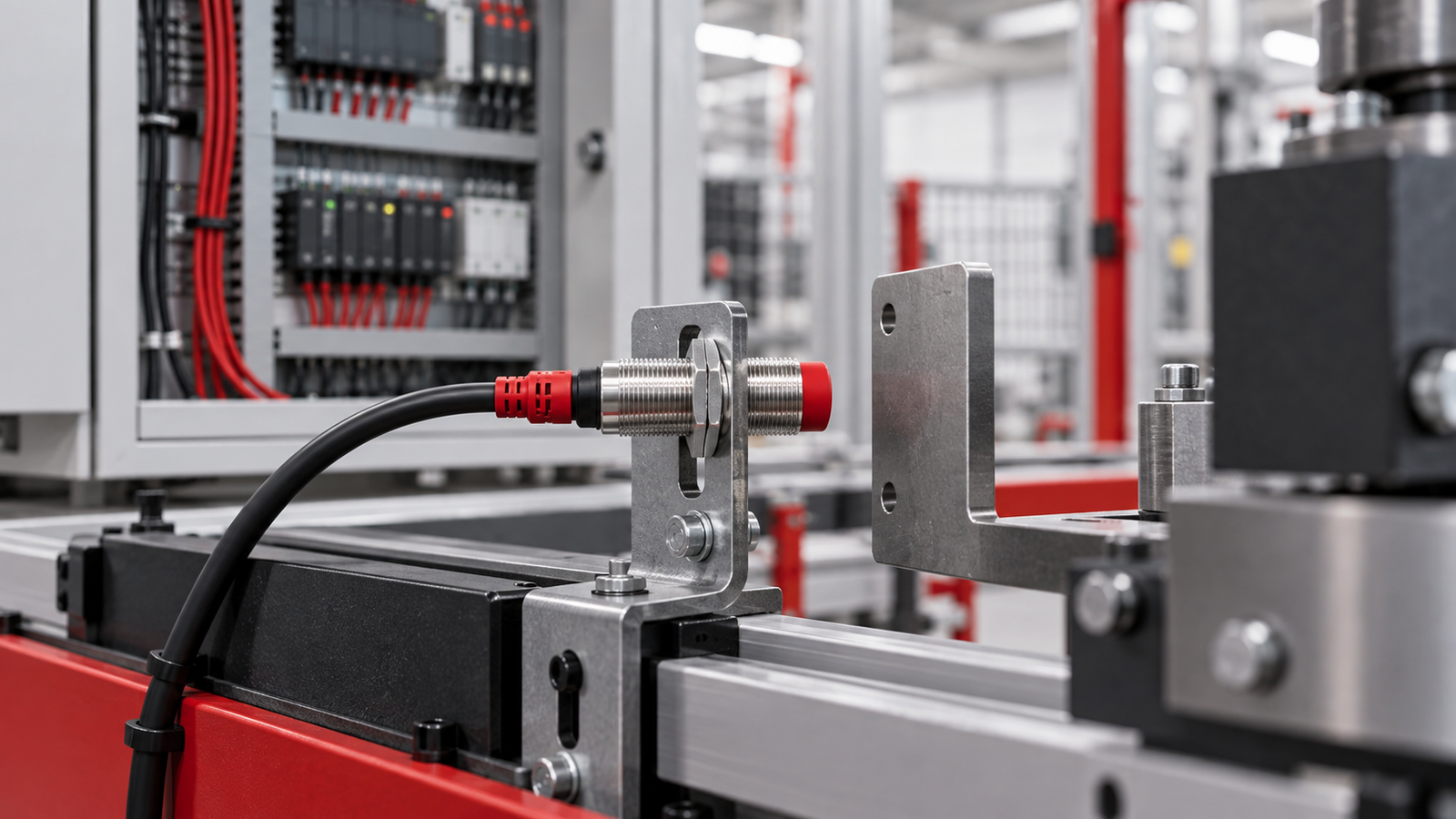
An inductive proximity sensor detects metal objects without requiring physical contact.
Inside the sensor, an oscillator produces an alternating electromagnetic field at the sensing face. When a metallic target enters that field, currents induced in the target affect the oscillator. The sensor electronics detect the change and switch the output.
Schneider Electric's technical documentation describes the same operating principle and identifies applications such as detecting machine positions and counting metal objects.
Iportal
The lack of mechanical contact is one reason these sensors are widely used on automated machinery. There is no lever that needs to be physically pushed every time an object passes the detection point.
Inductive sensor or limit switch?
Both devices can tell a control system that something has reached a particular position, but they do it differently.
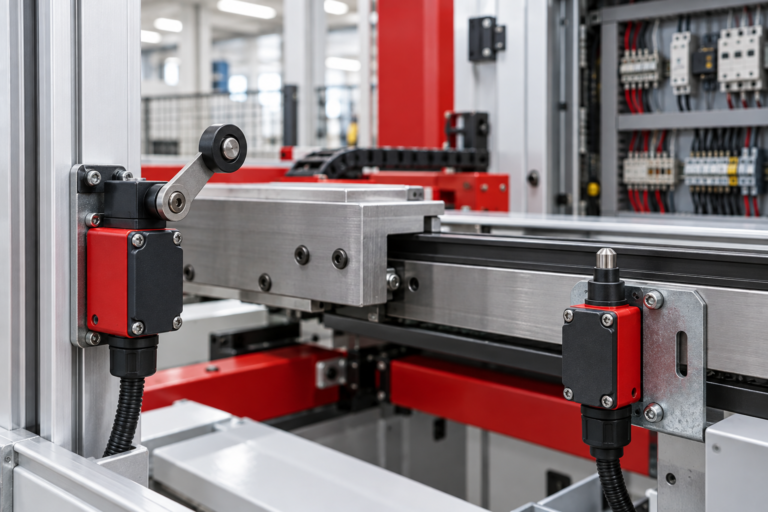
A mechanical limit switch needs physical movement of its actuator.
An inductive proximity sensor can detect a suitable metallic target before it physically touches the sensing face.
That can be useful for detecting metal machine parts, cams, stops, gears or components moving along production equipment.
Siemens documentation describes inductive proximity switches as devices used to detect the position of metallic parts and convert that detection into electrical signals that can then be processed by equipment such as a PLC.
Siemens Industry Support
This does not make an inductive sensor universally better than a limit switch. The correct detection method depends on the machine.
What does sensing distance mean?
Every proximity sensor has a defined detection range.
A specification such as Sn 8 mm, for example, refers to the sensor's nominal sensing distance under the manufacturer's specified test conditions.
Do not read that figure as a promise that every piece of metal will always be detected at exactly 8 mm.
Target material, target dimensions, mounting conditions, temperature and other factors can affect real operating distance.
This becomes particularly important when replacing a sensor on a machine where the target cannot physically move closer to the sensing face.
The metal being detected matters
Inductive does not mean "all metals at exactly the same distance."
Standard inductive sensors can respond differently to different target materials.
For example, Schneider Electric states that a conventional inductive proximity sensor tested against a standard mild-steel target may have a reduced sensing range when detecting aluminium. Its published example notes that aluminium can produce roughly 40% of the rated range for certain standard sensors, while specialized all-metal or non-ferrous designs can behave differently.
Schneider Electric
That figure belongs to the Schneider products discussed in its technical FAQ; it should not be applied blindly to every sensor.
The practical lesson is more important:
When sensing distance is tight, tell the supplier what material the target is made from.
A sensor that works comfortably with a steel target may behave differently when the machine is changed to aluminium or another metal.
Flush vs non-flush mounting
Two sensors with the same thread diameter can require different mounting arrangements.
A flush-mountable or shielded inductive sensor can be installed with its sensing face surrounded by metal according to the manufacturer's installation requirements.
A non-flush or unshielded sensor normally needs clearance around the sensing face because surrounding metal can interact with its sensing field.
Schneider explains that shielded sensors have little lateral field effect and can be embedded in metal, while non-shielded sensors require surrounding clearance and can offer a greater sensing range depending on the model.
Schneider Electric
Its XS catalogue likewise specifies that non-flush sensors require side clearance when mounted near metal.
Iportal
This is an easy detail to miss when replacing a sensor inside a steel machine bracket.
If the original was flush-mountable and the replacement is not, simply screwing it into the same metal bracket may produce unreliable detection.
What do PNP and NPN mean?
Many industrial DC proximity sensors use three wires: two for power and one for the output signal.
The output can commonly be PNP or NPN.
Schneider's XS documentation describes the distinction this way: a PNP output switches the positive supply toward the load, while an NPN output switches toward the negative side.
Iportal
The input circuit receiving that signal must be compatible with the sensor output.
This is particularly important when the sensor connects to a PLC.
Replacing an NPN sensor with a PNP version simply because both are 24 VDC sensors can leave the machine input unable to interpret the signal correctly.
NO and NC are separate from PNP and NPN
Another common source of confusion is treating PNP/NPN and NO/NC as the same specification.
They describe different characteristics.
PNP or NPN describes the output switching arrangement.
NO or NC describes the normal switching state or function defined for the sensor.
For example, Schneider currently publishes three-wire DC inductive sensors in combinations including PNP with normally open output. Its catalogue also documents NO and NC options across the range.
Eshop
+1
When replacing a sensor, check both specifications.
"PNP sensor" alone is not a complete replacement description.
Two-wire and three-wire sensors should not be mixed up
Not every proximity sensor uses the same wiring architecture.
Three-wire DC sensors commonly have separate positive supply, negative supply and output conductors.
Two-wire designs operate differently because the device is connected within the load circuit.
Manufacturers also offer sensors for different supply arrangements. Schneider's current XS portfolio, for example, includes three-wire DC models as well as two-wire AC/DC designs.
Eshop
+1
Do not convert between these types by matching wire colours or improvising connections.
Use the wiring diagram for the exact sensor and verify compatibility with the machine's input circuit.
M12, M18 and M30 do not describe sensing performance
Threaded cylindrical sensors are often identified by housing sizes such as M12, M18 and M30.
These dimensions help determine mechanical fit.
They do not tell you everything about electrical performance.
Two M18 sensors can have different sensing distances, outputs, connection types, voltage ranges and mounting requirements.
Even within a single manufacturer's range, an M18 body can appear in several configurations.
When ordering a replacement, the full part number is therefore far more useful than saying, "I need an M18 proximity sensor."
Cable or connector?
Some sensors have a permanently attached cable.
Others use connectors such as M8 or M12.
Connectorized sensors can make replacement easier because the machine cable can remain installed while the sensor itself is changed. Schneider lists both pre-cabled and connector versions within its industrial inductive sensor portfolio.
Iportal
For replacements, check the connector size and pin arrangement rather than assuming every M12 connector is wired identically for every sensor configuration.
Environment matters
A proximity sensor installed inside protected machinery has different requirements from one exposed to coolant, water, dust or frequent cleaning.
Manufacturers therefore specify environmental characteristics for individual sensor models, including enclosure protection and operating temperature.
For example, Schneider currently publishes particular XS models with IP65, IP67 and IP69K protection.
Eshop
Those ratings apply to the cited Schneider product, not automatically to INTEKS sensors or another manufacturer's products.
When selecting a sensor, check the environmental rating of the exact model against the actual installation.
Why a sensor can give intermittent detection
An intermittent sensor is not automatically a failed sensor.
Start with the target.
Is it still passing through the intended sensing area? Has a bracket moved? Has the target material changed? Is the gap larger than before?
Then inspect the sensor mounting and wiring.
If a non-flush sensor has been installed too deeply inside metal, surrounding material can affect operation. Damaged cables and loose connectors can also produce intermittent signals.
Finally, verify the electrical side. Confirm supply voltage and check whether the sensor output actually changes when the correct target enters the detection area.
Replacing components before checking these basics can turn a simple alignment problem into repeated sensor purchases.
A better replacement checklist
When an existing inductive sensor needs replacement, record:
Complete manufacturer and model number
Supply voltage
PNP or NPN output
NO or NC function
Number of wires
Nominal sensing distance
Flush or non-flush mounting
Housing/thread size
Target material
Cable or connector type
Required environmental protection
Take a photograph showing the sensor installed on the machine as well.
That image can reveal mounting conditions that a product label cannot.
What to send when requesting a sensor from INTEKS
For a replacement, send the old sensor's complete model number, clear label photographs and a picture showing how it is mounted.
Include the target material and approximate detection gap if known.
For a new machine, provide the supply voltage, required output type, target material, sensing distance, mounting arrangement, connection preference and operating environment.
INTEKS supplies industrial electrical control and automation components, including sensors, for panel builders, contractors, maintenance teams and industrial users. Providing the application information gives a much stronger basis for identifying an appropriate option than selecting a sensor from its diameter alone.
Frequently asked questions
Can an inductive proximity sensor detect plastic?
A standard inductive proximity sensor is intended for metallic targets. Detection of non-metallic materials normally requires another sensing technology, such as capacitive, photoelectric or ultrasonic sensing depending on the application. ABB's sensor documentation similarly distinguishes inductive sensors for metal from capacitive sensors capable of detecting a broader range of materials.
ABB Library
Can an inductive sensor detect aluminium?
Yes, suitable inductive sensors can detect aluminium, but the sensing distance of a conventional sensor may differ from its response to the standard steel target used for its nominal rating. Check the manufacturer's correction information for the exact sensor.
Schneider Electric
What is the difference between PNP and NPN sensors?
For common three-wire DC sensors, PNP switches toward the positive supply side while NPN switches toward the negative side. The PLC or receiving circuit must be compatible with the chosen output.
Iportal
Can I replace a flush sensor with a non-flush sensor?
Not without checking the mounting arrangement. Non-flush sensors normally require clearance around their sensing face, while flush-mountable designs are intended for installation within surrounding metal under their specified mounting conditions.
Schneider Electric
+1
Why does my proximity sensor's LED switch but the PLC receives no signal?
The sensor may be detecting the target while the electrical output is incompatible with the input circuit or the wiring is incorrect. Check supply voltage, PNP/NPN configuration, NO/NC function, connector pinout and PLC input wiring against the documentation for both devices.
Related INTEKS guides
- Switch Disconnector vs Circuit Breaker: What Is the Difference?
- MPCB vs MCB: Why Motor Protection Needs More Than an Ampere Rating
- Browse all INTEKS technical insights
For project requirements, component identification or a panel enquiry, contact the INTEKS team with the relevant rating, application and existing product details.
For the applicable standard and current edition, consult the official IEC publication search.