Quick technical guide: This article explains power factor correction capacitor banks: what they do and when an industrial site needs one for panel builders, contractors, maintenance teams and industrial electrical buyers.
An industrial facility can have motors, transformers and other equipment operating normally while still drawing more current from the electrical network than the useful work alone would suggest.
The reason is reactive power.
Many AC loads need reactive power to establish magnetic fields. That reactive demand increases the apparent power carried by cables, transformers and switchgear even though it does not represent useful mechanical output.
Power factor correction is used to reduce that unnecessary reactive demand from the upstream electrical supply.
One common method is a capacitor bank.
What is power factor?
In an AC system, three quantities are useful to distinguish:
Active power (kW) is the power doing useful work.
Reactive power (kvar) is associated with the electric and magnetic fields required by reactive loads.
Apparent power (kVA) represents the combined electrical demand placed on the supply.
Power factor expresses the relationship between active and apparent power.
A load with poor power factor requires more apparent power to deliver the same useful active power.
Schneider Electric's current power-factor-correction documentation notes that low power factor increases current flow and electrical losses, while capacitor banks supply capacitive reactive power to reduce the reactive current drawn from the source.
Product Info
+1
Why are motors important here?
Industrial sites often contain large numbers of induction motors.
Motors require active power to produce mechanical output, but their magnetic fields also require reactive power.
Transformers and some other inductive equipment behave similarly.
If that reactive demand is supplied entirely through the incoming electrical network, upstream cables, transformers and switchgear carry both the useful and reactive components of current.
A correctly engineered capacitor installation supplies part of the reactive requirement locally.
The upstream system then has less reactive current to carry.
This is the basic reason power factor correction can reduce apparent-power demand and release electrical capacity. Schneider describes capacitor compensation as reducing kVA demand and consequently unloading transformers and switchgear.
Schneider Electric
Does a capacitor bank reduce kW consumption?
This point is frequently misunderstood.
A capacitor bank does not make a 30 kW mechanical load suddenly require half as much useful power.
Its primary purpose is reactive-power compensation.
Improving power factor can reduce current and associated distribution losses, and it may reduce charges where the utility's tariff penalizes poor power factor or reactive energy. But those effects are different from claiming that a capacitor bank directly removes the machine's active-power requirement.
For a business evaluating PFC equipment, the electricity tariff should therefore be checked alongside the electrical measurements.
Do not estimate financial savings from the capacitor's kvar rating alone.
Fixed or automatic capacitor bank?
The load profile determines how compensation should behave.
Fixed compensation
A fixed capacitor arrangement provides a set amount of reactive compensation whenever it is connected.
This can suit a load whose reactive requirement is reasonably predictable and tied to the operation of specific equipment.
Siemens documentation identifies individual fixed compensation for loads such as motors and transformers, along with group and centralized compensation arrangements.
Siemens Industry
Automatic compensation
A factory can behave very differently.
At 9:00 AM, several production lines may be running. Later, half of them may stop. A large motor may start while another process shuts down.
A fixed amount of compensation cannot follow all of those changes.
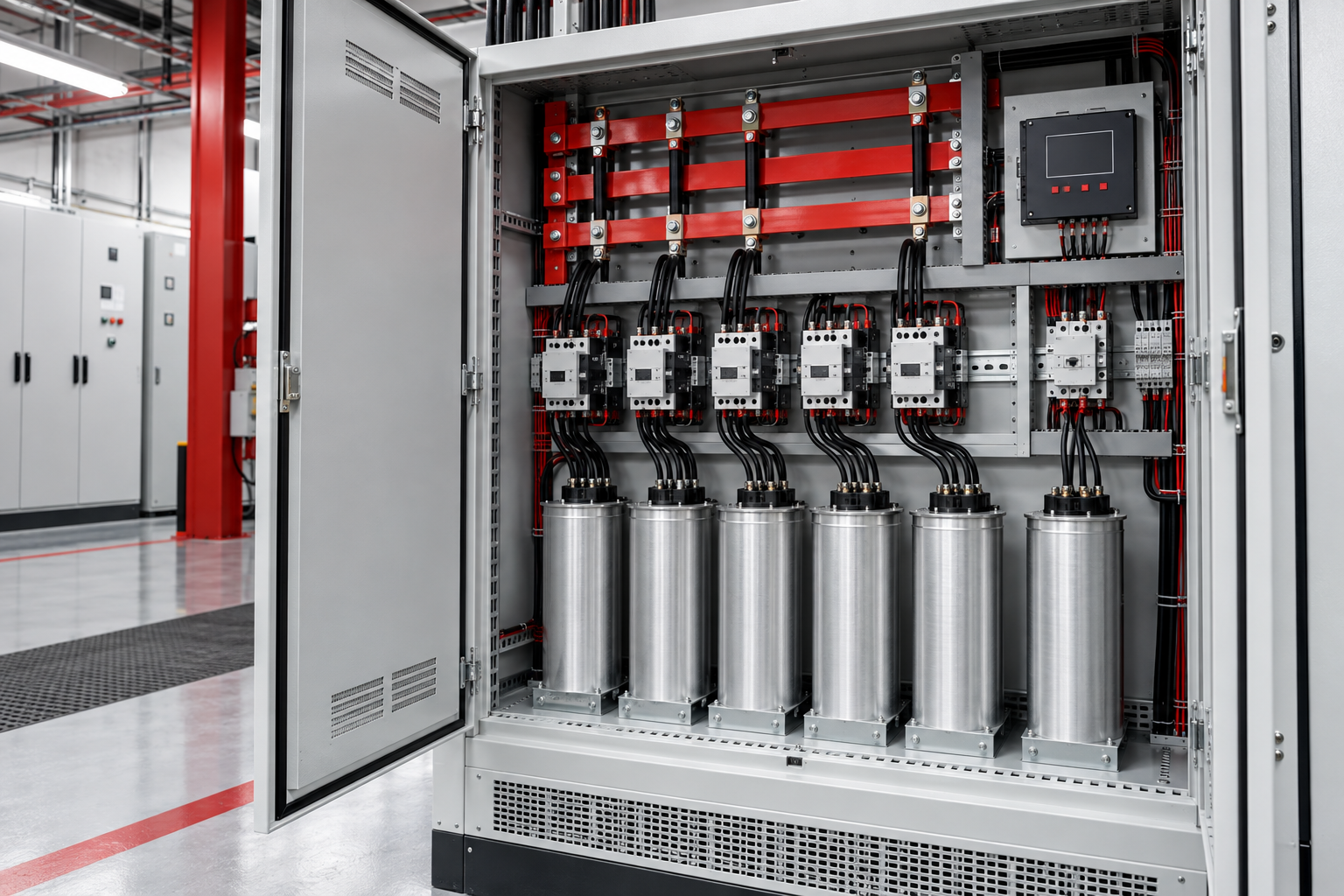
Automatic capacitor banks divide the available compensation into stages. A power factor controller monitors the electrical system and switches capacitor stages as required.
Schneider's current PowerLogic PFC documentation describes controllers that automatically connect and disconnect stages to maintain a configured power factor.
Product Info
This avoids treating a changing industrial load as though it were constant.
Why shouldn't you simply install the largest capacitor bank possible?
Because too much compensation creates another problem.
The goal is not "maximum capacitance."
The required reactive power needs to be calculated from the actual load and the desired power factor.
ABB gives the standard relationship as:
Qc = P × (tan φ₁ − tan φ₂)
where P is active power, φ₁ represents the existing power-factor angle, φ₂ represents the desired power-factor angle, and Qc is the required capacitor reactive power.
ABB Library
For an existing factory, measured operating data is usually more useful than guessing from the total installed motor horsepower.
The plant may rarely operate every load simultaneously.
What happens if compensation is too high?
An oversized or incorrectly controlled bank can lead to overcompensation when the inductive load falls.
Instead of correcting lagging reactive demand toward the required target, the installation can move into a leading power-factor condition.
This is one reason automatic staging is useful for facilities with changing loads.
The controller can remove capacitor stages when less compensation is required.
A capacitor bank should therefore be sized around the site's electrical behaviour rather than treated as a generic add-on to the main panel.
Harmonics change capacitor-bank design
This is one of the most important checks on a modern industrial site.
Variable-frequency drives, rectifiers, UPS systems and other nonlinear equipment can introduce harmonic currents into the electrical network.
Adding ordinary capacitors without studying those conditions can create unwanted interaction between the capacitors and the system inductance.
ABB's power-factor-correction technical guide specifically identifies the presence of nonlinear loads as an issue that must be considered when applying capacitors.
ABB Library
For networks with harmonic content, manufacturers offer detuned capacitor banks.
A detuned system combines capacitors with reactors. Schneider explains that the capacitor-and-reactor combination is tuned below the dominant harmonic order to help avoid resonance and harmonic amplification.
Product Info
+1
That does not mean every site containing a VFD automatically requires the same detuning arrangement.
A power-quality assessment should establish the actual network conditions.
Why capacitor switching needs suitable contactors
A capacitor stage is not an ordinary motor load.
When a capacitor is energized, substantial transient current can occur during charging. Switching one capacitor bank while other energized stages are already connected can make the conditions more demanding.
Capacitor-bank designs therefore use switching equipment selected for capacitor duty.
Schneider's detuned-bank documentation specifically identifies capacitor-switching-rated contactors as part of its PFC equipment.
Schneider Electric
ABB likewise publishes dedicated equipment for capacitor-bank switching, including products designed for single and back-to-back bank operation.
ABB Electrification
A standard contactor should not be substituted solely because its continuous-current rating appears large enough.
Capacitors also need discharge time
A disconnected capacitor can retain electrical charge.
Industrial capacitor installations therefore use discharge arrangements according to the capacitor and system design.
This becomes especially relevant during maintenance and when capacitor stages are repeatedly switched.
A capacitor that has been disconnected should never be assumed safe merely because the contactor or isolator is open.
Follow the manufacturer's discharge requirements and the site's electrical isolation procedure before working on the equipment.
Where should power factor correction be installed?
There is no single correct location for every facility.
Schneider identifies possible installation points including the medium-voltage substation, main low-voltage switchboard, secondary switchboards and individual machine terminals.
Schneider Electric
The best arrangement depends on where reactive power is being consumed and what the project is trying to achieve.
Individual compensation near a large steady motor can reduce reactive current through more of the upstream distribution path.
Centralized automatic compensation can be easier to manage when many loads operate with changing schedules.
Some installations use a combination.
What should be measured before selecting a capacitor bank?
Do not start with enclosure size or a guessed kvar figure.
For an existing industrial site, useful information includes:
Existing power factor under representative operating conditions
Active power demand
Reactive power demand
System voltage and frequency
Load variation throughout production
Transformer information
Harmonic measurements where nonlinear loads are significant
Existing compensation equipment
Utility tariff or power-factor requirements
Measurements should cover meaningful operating conditions rather than a single quiet moment.
A factory's electrical profile at lunch break may look very different from its profile during peak production.
A practical purchasing mistake
Consider this request:
"Our factory power factor is low. Please quote a 100 kvar capacitor bank."
Where did 100 kvar come from?
If it came from an old panel label, another factory, or a quick guess, the supplier still does not know whether it matches the present installation.
A better enquiry provides recent electrical measurements, system voltage, load profile, existing power factor, desired target and information about VFDs or other harmonic-producing loads.
That gives an electrical engineer enough information to determine whether the proposed compensation is sensible and whether a conventional or detuned arrangement needs consideration.
Existing capacitor bank not correcting properly?
Do not immediately add more capacitors.
Check whether all stages are actually switching.
A failed capacitor stage, contactor problem, fuse operation, controller setting, measurement issue or deterioration in the capacitor equipment can reduce effective compensation.
The plant load itself may also have changed.
A bank designed years ago for one production setup may no longer match a facility containing new motors, drives or machinery.
Measure first. Then diagnose the bank.
What to send when requesting PFC equipment from INTEKS
For a new project, provide available load measurements, existing and target power factor, system voltage and frequency, estimated or measured reactive demand, load profile and information about significant nonlinear loads.
For an existing bank, include photographs of the panel, controller, capacitor labels and switching components together with available electrical measurements.
INTEKS supplies industrial electrical protection, control and automation components for panel builders, contractors, maintenance teams and industrial users. Power factor correction should be approached as an electrical-system requirement rather than selecting components from kvar values alone.
Frequently asked questions
Does a capacitor bank reduce an industrial electricity bill?
It can reduce charges associated with poor power factor or reactive energy where the utility tariff applies them, and lower current can reduce distribution losses. The actual financial effect depends on the site's tariff, load profile and electrical system.
Schneider Electric
What is kvar in a capacitor bank?
kvar is the unit used for reactive power. A capacitor bank's kvar rating describes the reactive compensation it can provide under its specified operating conditions.
Should a factory use a fixed or automatic capacitor bank?
A steady load may suit fixed compensation. Facilities with loads that regularly start and stop often require staged automatic compensation so the connected kvar can follow changes in reactive demand.
Do VFDs affect capacitor-bank selection?
They can. VFDs and other nonlinear loads can contribute harmonic currents. Harmonic conditions should be assessed because capacitors can interact with network inductance. Detuned capacitor banks use reactors to address resonance and harmonic-amplification concerns in suitable applications.
Product Info
+1
How is the required capacitor-bank size calculated?
The required reactive compensation can be calculated from active power, existing power factor and desired power factor. For existing industrial installations, measured operating data should be used where possible rather than estimating from connected load alone.
ABB Library
Related INTEKS guides
- MPCB vs MCB: Why Motor Protection Needs More Than an Ampere Rating
- Soft Starter vs Star-Delta Starter: Choosing the Right Starting Method for an Industrial Motor
- Browse all INTEKS technical insights
For project requirements, component identification or a panel enquiry, contact the INTEKS team with the relevant rating, application and existing product details.
For the applicable standard and current edition, consult the official IEC publication search.