Quick technical guide: This article explains switch disconnector vs circuit breaker: what is the difference? for panel builders, contractors, maintenance teams and industrial electrical buyers.
Open an industrial electrical panel and you may find a rotary-operated switch near the incoming supply. It can look substantial enough to be mistaken for a circuit breaker.
That assumption can cause a serious specification error.
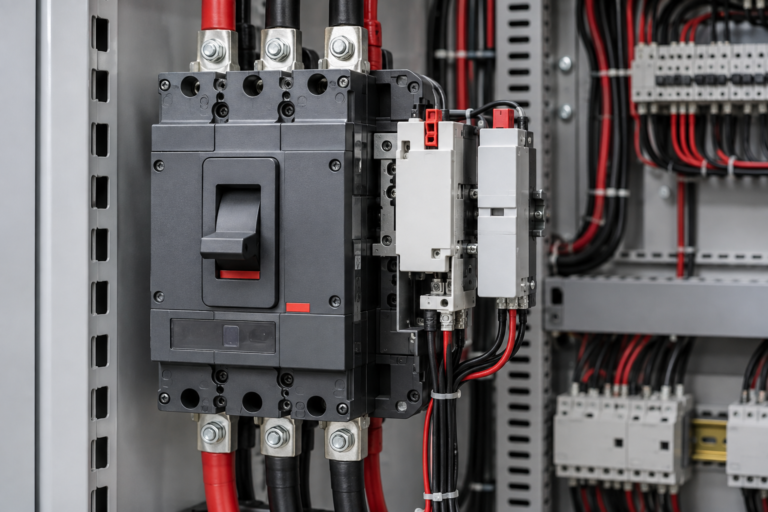
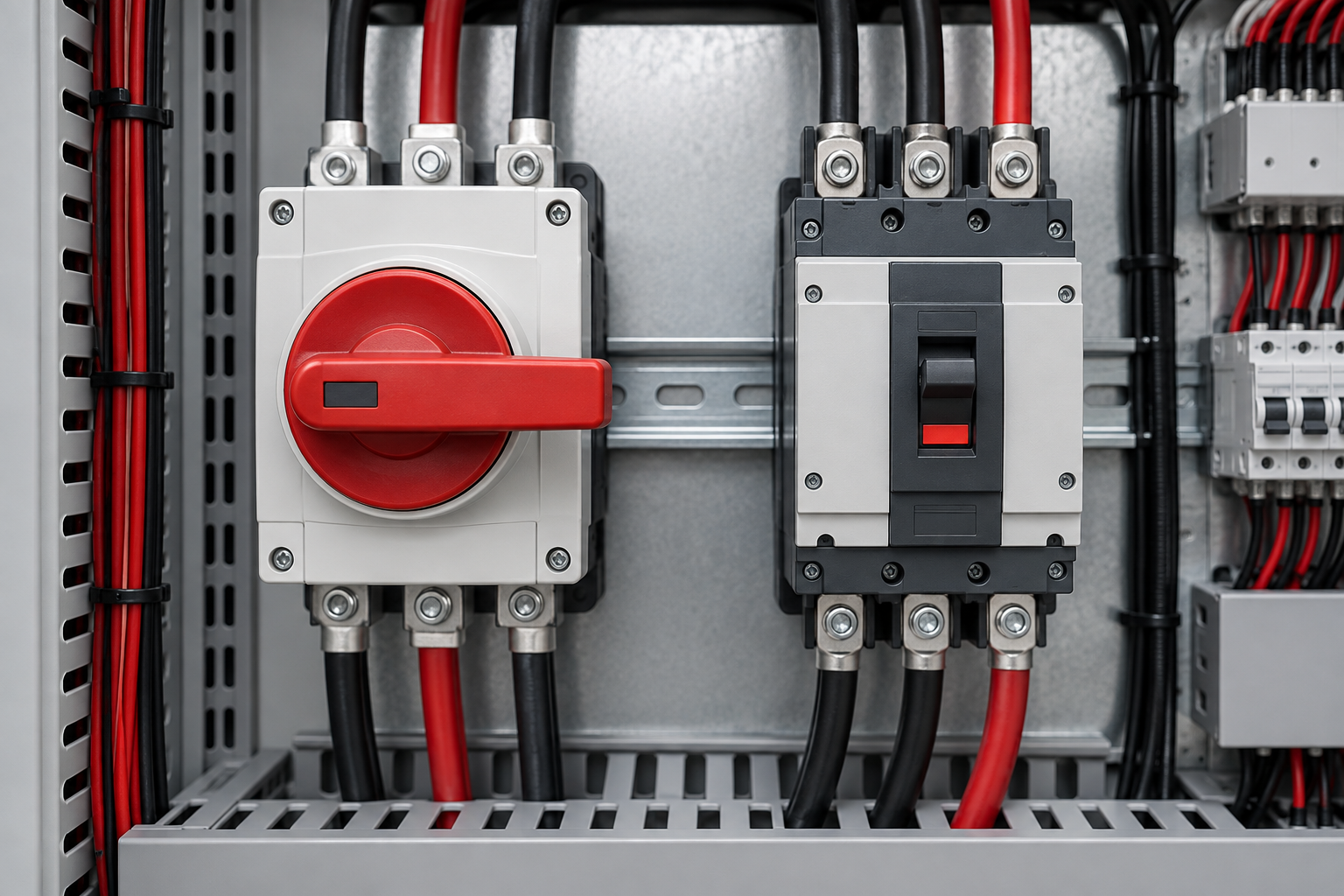
A switch disconnector is primarily used for switching and isolation. A circuit breaker adds a different function: it can interrupt fault current when its protective mechanism detects specified abnormal conditions.
The distinction matters when designing a panel, replacing an incoming device, or preparing a purchase request.
What does a switch disconnector do?
A switch disconnector combines two functions.
It can act as a switch for making and breaking current under the normal circuit conditions for which it is rated. It also provides an isolation function when open.
Schneider Electric describes switch disconnectors as combining the properties of disconnectors used for isolation and load switches used for normal switching.
Schneider Electric
That makes them useful as main disconnecting devices in many industrial installations.
ABB lists switch-disconnector applications including control panels, low-voltage switchgear, motor control centres, HVAC equipment, pumps and conveyors.
ABB Library
The exact suitability still depends on the ratings and documentation of the individual device.
What does electrical isolation mean?
Opening a circuit and providing isolation are related concepts, but they should not automatically be treated as identical.
For equipment intended to perform an isolation function, the open state has to meet defined requirements so that the downstream section can be separated from its electrical source.
Schneider's documentation for its switch-disconnector range describes the isolation function as providing the defined isolation withstand between open contacts when the device is in the open position.
Schneider Electric
This is why a generic ON/OFF switch should not automatically be assumed suitable as an isolator.
If isolation is required, verify that function in the manufacturer's technical documentation for the exact device.
Can a switch disconnector open a circuit while it is carrying load?
A correctly specified switch disconnector can make and break normal load current within its published ratings and utilization conditions.
That is one of the differences between a switch disconnector and a device intended only for isolation.
But "can switch load current" should not be interpreted as "can clear any current that occurs."
A short circuit is a different situation.
Does a switch disconnector protect against short circuits?
This is the critical distinction.
A switch disconnector should not be treated as a circuit breaker.
Schneider Electric explains that a load switch can make, carry and break current under normal circuit conditions and may have short-time withstand and short-circuit making ratings. It does not, however, have the short-circuit breaking function of a protective circuit breaker.
Schneider Electric
ABB makes the same distinction in its switch-disconnector documentation: a circuit breaker can clear fault currents, whereas a switch disconnector provides switching and isolation rather than the circuit breaker's fault-clearing function.
ABB Group
A panel using a switch disconnector therefore still needs the appropriate protection strategy elsewhere in the circuit.
Depending on the design, that may involve circuit breakers, fuses or another engineered protective arrangement.
Then why do switch disconnectors have short-circuit ratings?
This is where datasheets can become confusing.
You may encounter values such as Icw and Icm.
They do not turn the device into a circuit breaker.
Icw: short-time withstand current
Icw relates to the current a device can withstand for a specified short duration under defined conditions.
Schneider notes that isolating devices can be assigned a rated short-time withstand capability, commonly specified for a defined period such as one second.
Schneider Electric
The exact value and duration must come from the datasheet of the device being considered.
Icm: short-circuit making capacity
Icm concerns the ability to close onto a short-circuit current under specified conditions.
Again, that does not mean the switch disconnector is designed to interrupt that fault current.
This is a good example of why copying the largest "kA" figure from a datasheet without understanding its symbol can lead to the wrong component selection.
Switch disconnector vs circuit breaker in a panel
Consider a simplified incoming arrangement:
Supply → Circuit protection → Switch disconnector → Distribution/load
The circuit protection deals with specified overcurrent or fault conditions.
The switch disconnector provides controlled switching and isolation.
Real installations can use different architectures, and some protective devices themselves can also be suitable for isolation when specifically designed and documented for that function.
The device names alone are therefore not enough. The required functions should be defined first.
Ask:
Does the device need to provide isolation?
Does it need to switch the normal load?
Does it need to detect and interrupt overload or short-circuit current?
Once those questions are answered, component selection becomes much clearer.
Why utilization category matters
Two switch disconnectors with the same current figure are not automatically suitable for the same load.
The type of load and switching duty affect device selection.
A resistive load, mixed industrial load and motor can impose different switching conditions.
ABB's current switch-disconnector catalogue specifically identifies applications ranging from simple isolation to demanding motor-load disconnection.
ABB Library
For that reason, the rated current should be read together with the utilization category, voltage and application information in the manufacturer's documentation.
Selecting only by ampere rating misses part of the specification.
Three-pole or four-pole?
Industrial switch disconnectors are available with different pole configurations.
ABB, for example, offers three- and four-pole versions within its enclosed switch-disconnector portfolio.
ABB Group
Which conductors need to be switched depends on the electrical system and installation design.
Do not decide that requirement by copying another panel that happens to use the same nominal voltage.
The system earthing arrangement, neutral requirements, local rules and engineering design need to be considered.
Why are some isolator handles padlockable?
A local disconnect near machinery is often used during maintenance.
A padlockable handle can allow the switch to be secured in a defined position as part of an appropriate isolation procedure. ABB lists padlockable handles and cover interlocks among features used on its enclosed switch-disconnector products for maintenance and installation applications.
ABB Group
+1
The presence of a red rotary handle alone does not establish the device's electrical capabilities or make an installation safe for maintenance.
Isolation procedures still need to follow the site's safety requirements, including verification that hazardous energy has actually been controlled.
Enclosed or panel-mounted?
The installation environment changes the requirement.
Inside a suitable switchboard enclosure, a panel-mounted device may be appropriate.
A local machine isolator mounted in a workshop, plant area or outdoors may need its own enclosure and suitable environmental protection.
ABB offers enclosed switch disconnectors in materials including plastic, sheet steel, stainless steel and aluminium, demonstrating how enclosure selection can vary with the operating environment.
ABB Group
Do not copy ABB's enclosure ratings onto another manufacturer's product. Check the actual IP rating, material and environmental limitations of the device being purchased.
AC and DC switching should not be treated as interchangeable
A switch suitable for an AC application should not automatically be used on DC because its voltage and current figures appear adequate.
DC switching creates different interruption conditions.
Manufacturers therefore publish dedicated DC switch-disconnector products and application data. ABB, for example, has a separate DC switch-disconnector range for applications including PV, energy storage, EV charging and DC distribution.
ABB Group
For a DC installation, use a device explicitly documented for the required DC voltage, current, pole configuration and utilization category.
Replacing an existing switch disconnector
A maintenance request sometimes arrives as:
"Need the same 100A main switch."
That description is incomplete.
Before ordering, record the full existing model number and check:
System voltage
AC or DC application
Number of poles
Rated operational current
Utilization category
Required isolation function
Mounting arrangement
Handle and shaft arrangement
Auxiliary contacts, if used
Enclosure requirement, if applicable
Also identify what device provides short-circuit and overload protection.
If the old switch shows heat damage, melted terminals or severe discoloration, replacing it without checking connections and load conditions may leave the original problem unresolved.
What panel builders should specify on a new project
Start with the required function rather than a preferred product.
Define the circuit voltage and load. Determine the number of poles and switching duty. Establish whether the device must provide isolation and whether local operation, door coupling or padlocking is required.
Then check the manufacturer's data for the actual switch.
For applications involving motors or other demanding loads, pay particular attention to the relevant utilization category rather than relying only on the headline current rating.
The protective arrangement should be designed separately so that the switch disconnector is not expected to perform a fault-clearing function it was never intended to provide.
Sending a switch-disconnector enquiry to INTEKS
For a replacement, send clear photographs of the existing device and its complete label.
For a new panel, provide the system voltage, AC or DC supply, current requirement, number of poles, load type, required isolation arrangement, mounting method and any handle or enclosure requirements.
INTEKS supplies industrial electrical protection, control and switching components for panel builders, contractors, maintenance teams and industrial users. Giving the application details makes product identification far more reliable than asking for an "isolator" based only on ampere rating.
Frequently asked questions
Is a switch disconnector the same as a circuit breaker?
No. A switch disconnector provides switching and isolation functions within its ratings. A circuit breaker provides protective fault interruption according to its design.
ABB Group
+1
Can a switch disconnector be operated under load?
A switch disconnector designed and rated for load switching can make and break normal load current within its specified operating conditions. Always check the exact device documentation and utilization category.
Schneider Electric
Does a switch disconnector need a fuse?
Not necessarily as part of the device itself, but the circuit still needs an appropriate protection arrangement. Switch-fuse combinations also exist where switching, isolation and fuses are integrated into an engineered assembly.
Can I use an AC switch disconnector for DC?
Do not assume so. Use the manufacturer's documented DC ratings and configuration. Dedicated DC switch disconnectors exist because DC switching has different requirements.
ABB Group
What information should I provide when buying an isolator?
Provide the system voltage, AC/DC type, current, number of poles, load, required switching and isolation functions, mounting arrangement and existing model reference when applicable.
Related INTEKS guides
- Phase Failure and Phase Sequence Relays: What They Actually Do in a Three-Phase System
- Inductive Proximity Sensors: What to Check Before Buying or Replacing One
- Browse all INTEKS technical insights
For project requirements, component identification or a panel enquiry, contact the INTEKS team with the relevant rating, application and existing product details.
For the applicable standard and current edition, consult the official IEC publication search.