Quick technical guide: This article explains phase failure and phase sequence relays: what they actually do in a three-phase system for panel builders, contractors, maintenance teams and industrial electrical buyers.
A three-phase motor can have perfectly good bearings, a correctly selected contactor and suitable overload protection, yet still face trouble because the incoming supply is wrong.
One phase may disappear. Two phases may be connected in the wrong sequence after maintenance. The supply may become unbalanced. Voltage can also move outside the range expected by the equipment.
A phase monitoring relay watches the supply for selected conditions and provides a control output when the monitored supply is acceptable or when a fault is detected.
For panel builders and maintenance teams, the important part is knowing exactly which conditions a particular relay monitors. "Phase relay" is too broad a description for purchasing.
What is a phase monitoring relay?
A three-phase monitoring relay is connected to the electrical supply and checks specified characteristics of that supply.
Depending on the model, those characteristics can include:
Phase failure
Phase sequence
Phase imbalance or asymmetry
Undervoltage
Overvoltage
Neutral failure on suitable systems
These functions are not universal. One relay may monitor only phase failure and sequence, while another may combine several voltage-monitoring functions.
For example, Schneider Electric lists phase sequence, phase failure, phase imbalance and voltage monitoring among the functions available in its three-phase monitoring-relay range. ABB likewise documents monitoring relays with combinations of phase failure, sequence, imbalance, overvoltage and undervoltage detection.
Schneider Electric
+1
That is why the exact model documentation matters.
What happens when one phase is lost?
Consider a three-phase machine supplied through L1, L2 and L3.
If one phase disappears because of a blown fuse, loose connection, damaged conductor or another upstream problem, equipment downstream may no longer receive the supply conditions it was designed for.
A phase-failure relay can detect the missing phase and change the state of its output contacts.
Those contacts are commonly incorporated into a control circuit so that another device, such as a contactor, can be de-energized.
Schneider documents this behaviour in its monitoring equipment: when a monitored phase is lost, the relay output changes state rather than repairing the incoming supply.
Schneider Electric
+1
This distinction matters.
The monitoring relay detects the condition. The surrounding control circuit determines what happens next.
What is phase sequence?
A three-phase supply has a phase order.
For simplicity, imagine the intended order as:
L1 → L2 → L3
If two phases are interchanged, the sequence changes.
This can affect the direction of rotation of a three-phase motor. On equipment where direction matters, an incorrect sequence can therefore create an operational or mechanical problem.
Pumps, compressors, conveyors, fans and other motor-driven machinery are examples where unintended reverse rotation may be undesirable or damaging depending on the machine design.
A phase-sequence monitoring relay checks whether the incoming phases are connected in the expected order.
Siemens, for example, currently lists industrial monitoring relays specifically designed for phase failure, phase sequence and asymmetry monitoring.
Siemens Industry Mall
Does a phase sequence relay automatically swap the phases?
Do not assume that it does.
A standard monitoring relay can detect an incorrect phase sequence and change its output state without physically rearranging the incoming conductors.
Schneider Electric explicitly notes this distinction for its phase-sequence monitoring: the relay monitors the sequence and opens its output during a sequence fault, but does not automatically correct the wiring.
Schneider Electric
Automatic phase-sequence correction is a separate function that exists in some specialized monitoring products and control arrangements. ABB, for example, lists automatic phase-sequence correction on selected monitoring-relay models.
Empower
The datasheet needs to confirm whether that feature exists on the device being considered.
Phase failure and voltage imbalance are different conditions
A phase does not have to disappear completely for a three-phase supply to become problematic.
The voltages between phases can become unequal.
Some monitoring relays therefore include an asymmetry or phase-imbalance function in addition to simple phase-loss detection.
Schneider's RM17TE00, for example, monitors phase sequence, phase failure and asymmetry along with voltage conditions.
Schneider Electric
+1
This is useful when designing protection because a requirement to detect a completely missing phase is not necessarily the same as a requirement to monitor smaller supply imbalances.
Before ordering, determine which fault conditions the application actually needs to detect.
What about overvoltage and undervoltage?
Some three-phase monitoring relays also supervise voltage limits.
If the measured voltage moves beyond configured thresholds, the relay can change its output after the behaviour specified by that particular device.
Fault handling can differ between conditions.
For one Schneider monitoring relay, for example, phase failure and incorrect phase sequence cause immediate operation, while overvoltage and undervoltage can use a configurable time delay.
Schneider Electric
A delay can help distinguish a persistent voltage problem from a brief variation, where the relay and application are designed for such operation.
Do not transfer those exact timings or functions to another relay. They are product-specific.
A phase monitoring relay is not a replacement for an overload relay
The names can make these devices sound interchangeable. They are not.
A thermal or electronic overload relay is primarily concerned with protecting a motor against defined overload conditions according to its design.
A phase monitoring relay supervises electrical supply conditions.
A circuit breaker or fuse arrangement provides other parts of the circuit protection.
A motor-control panel may use several of these devices because each addresses a different problem.
For purchasing and maintenance, asking "which protection do I need?" is therefore less useful than identifying the actual fault that needs to be detected.
Where are phase monitoring relays useful?
They are commonly relevant where three-phase supply condition matters to the operation of equipment.
A panel designer might use one in a motor-control circuit so the contactor is permitted to energize only when the monitored supply satisfies the required conditions.
A maintenance team might encounter one when troubleshooting a machine that refuses to start even though the main supply appears to be present.
That second situation deserves attention.
If the monitoring relay is preventing operation, bypassing it without identifying the detected fault can remove a deliberate protection or interlocking function from the machine.
Check the supply and the relay indication against the manufacturer's documentation instead.
What should you check before buying one?
Start with the system voltage and supply configuration.
Then define what needs monitoring. Is phase loss enough? Does the machine also need phase-sequence protection? Is voltage imbalance important? Are overvoltage and undervoltage limits required?
Check the relay's measuring range against the actual system.
The output-contact arrangement also matters because those contacts need to integrate correctly with the control circuit.
If adjustable thresholds or delays are required, confirm that they exist on the exact model rather than assuming every monitoring relay provides them.
For replacement work, record the complete existing product reference and wiring before removing the old relay.
A photograph of the front label alone may not show enough information to identify every terminal or setting.
A useful purchasing example
Suppose a buyer asks for:
"One phase failure relay for a three-phase panel."
There are still several unanswered questions.
What is the system voltage? Does the panel require phase-sequence monitoring as well? Should the relay monitor voltage imbalance? What output contacts does the control circuit require? Is there an existing relay being replaced?
Compare that with:
"Three-phase supply monitoring required for phase loss and incorrect phase sequence. Existing panel details, system voltage, wiring and old relay reference attached."
The second enquiry gives the supplier a much stronger basis for identifying an appropriate option.
Troubleshooting a relay that will not energize
If a phase monitoring relay is preventing the control circuit from operating, do not start by replacing the relay.
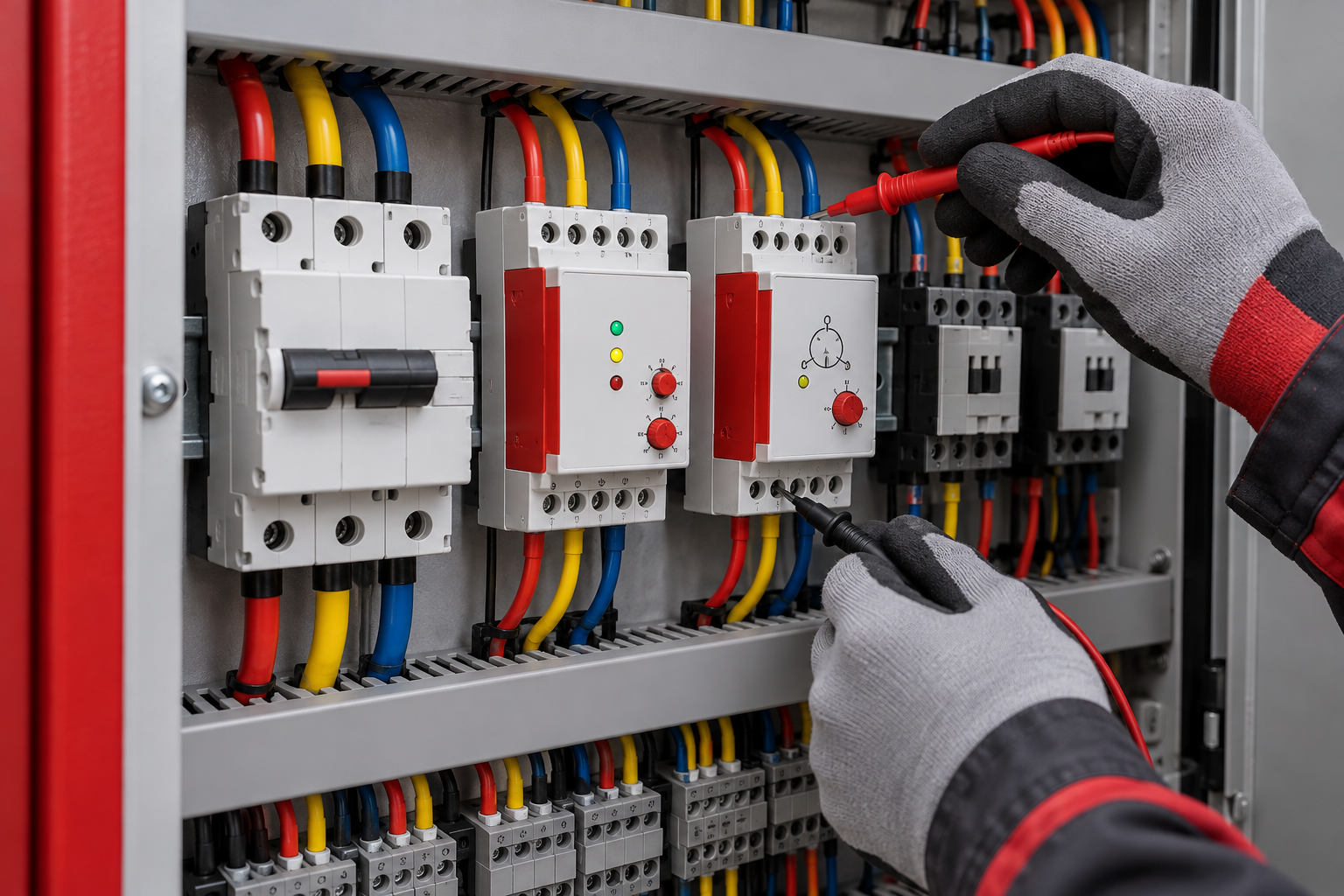
Verify the incoming phases and voltages using appropriate test equipment and safe electrical procedures. Check phase sequence where relevant. Compare relay indicators and settings with the manufacturer's manual.
Also inspect the wiring.
A monitoring relay can only respond to what reaches its measurement terminals. A loose terminal or wiring error can therefore appear to the relay as a supply problem.
Schneider's documentation for one phase-monitoring product notes that its output remains de-energized during conditions including phase loss, phase reversal, voltage imbalance and undervoltage.
Schneider Electric
The indication should be treated as diagnostic information, not proof that the relay itself has failed.
Before sending a phase-relay enquiry to INTEKS
For a new installation, provide the system voltage, number of phases, conditions that need monitoring, required output-contact arrangement and application.
For a replacement, add the existing relay model, clear photographs and available wiring information.
INTEKS supplies industrial electrical protection, control and automation components for panel builders, contractors, maintenance teams and industrial users. Supplying the actual application details makes component identification more reliable than requesting a device by a generic trade name alone.
Frequently asked questions
What is the difference between phase failure and phase sequence?
Phase failure means one or more phases are absent or outside the detection conditions defined by the monitoring device. Phase sequence refers to the order of the phases. A supply can have all three phases present while still having the wrong sequence.
Can a phase monitoring relay stop a motor?
Its output contacts can be incorporated into a motor-control circuit so that a contactor drops out or is prevented from energizing when a monitored fault occurs. The exact behaviour depends on the control circuit design.
Does every phase failure relay detect undervoltage?
No. Available functions vary by model. Some devices monitor only phase failure and sequence, while multifunction relays may also monitor imbalance, overvoltage, undervoltage or other conditions. ABB's CM-PFS, for example, is documented for phase failure and sequence, while other ABB monitoring models add voltage and imbalance functions.
Empower
+1
Can a phase sequence relay correct reversed phases automatically?
Not necessarily. Many devices only detect an incorrect sequence and change their relay output. Automatic sequence correction is a separate feature and must be verified for the specific product.
Schneider Electric
+1
What information should I provide when requesting a monitoring relay?
Provide the system voltage and configuration, required monitoring functions, output-contact requirement, application, existing product reference if replacing a relay, and any relevant control-circuit information.
Related INTEKS guides
- Thermal Overload Relays: What They Protect and What Electrical Buyers Should Check
- Switch Disconnector vs Circuit Breaker: What Is the Difference?
- Browse all INTEKS technical insights
For project requirements, component identification or a panel enquiry, contact the INTEKS team with the relevant rating, application and existing product details.
For the applicable standard and current edition, consult the official IEC publication search.